

The European car marketautomotive is rapidly evolving, as new propulsion technologies and electric propulsion are constantly increasing their market share.
The European automotive industry is facing one of the most critical periods in its modern history, as it is called upon to strike a balance between the demands of the green transition, international competition, geopolitical uncertainties , and the need to maintain its industrial strength. The data from the European Automobile Manufacturers’ Association (ACEA) for May 2026 and the first five months of the year paint a picture of a market that maintains its stability despite the challenges, while at the same time undergoing a transformation that would have seemed unimaginable just a few years ago. New car registrations remain in positive territory, electrification technologies are steadily gaining ground, and Europe is striving to maintain its leading role in a global industry that is changing at an unprecedented pace. This situation affects not only the automotive industry but the European economy, as the automotive sector is one of the most important pillars of growth, employment, investment, and technological innovation.
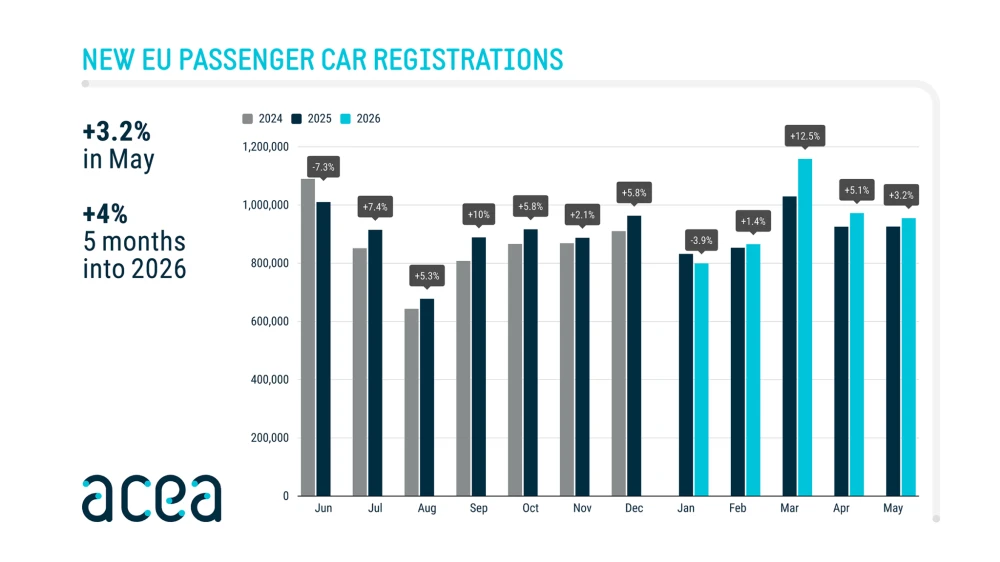
The overall market outlook remains remarkably resilient. According to Topspeed.gr, between January and May 2026, more than 4.5 million new passenger cars were registered in the European Union, marking a marginal but significant increase compared to the same period last year. This development takes on particular significance when considering the pressures that many European economies continue to face, the slowdown observed in major markets, and the challenges posed by intensifying competition from new global players. Despite the difficulties, the market is showing resilience and continues to support one of the most important productive sectors of the European economy.
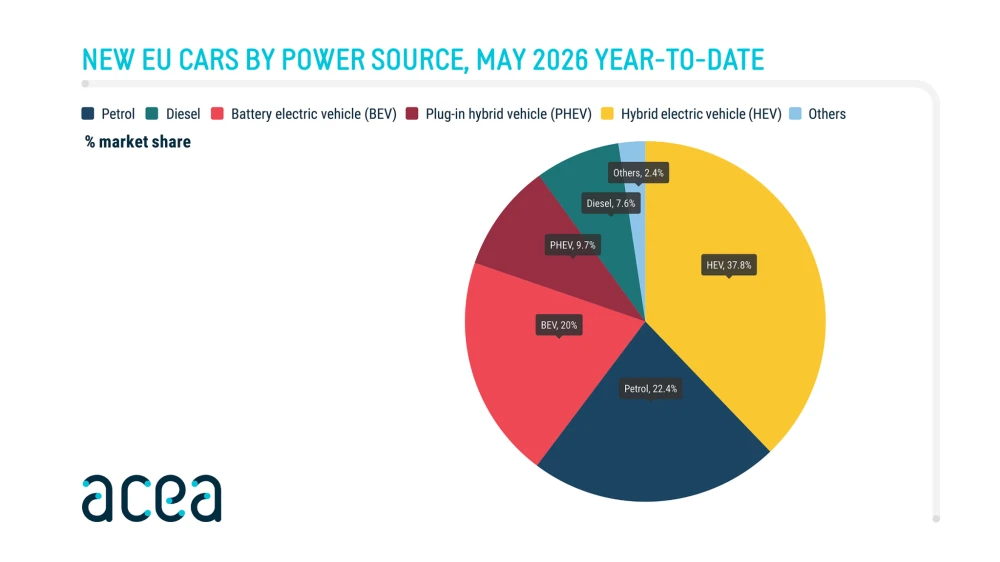
Behind the overall figures, however, a deeper shift is taking place that affects not only the preferences of consumers but also the future of European industry. Hybrid cars have emerged as the largest market segment, all-electric vehicles now account for more than 20% of total registrations, plug-in hybrids are gaining momentum once again, while gasoline and diesel continue to decline. This picture reflects Europe’s transition to a new mobility model, where technological innovation, investments and environmental goals act as catalysts for change.
Hybrids: The cornerstone of Europe’s transition
Hybrid cars remain the driving force of the European market. The segment continues to grow at a steady pace and now accounts for the largest share of new registrations in the European Union.
The dominance of hybrids is no coincidence. They represent a technology that combines improved energy efficiency with ease of use, allowing drivers to enjoy the benefits of electrification without radically changing their daily habits. This balance explains why millions of European consumers are choosing them as the first step toward a new era of motoring.
At the same time, the strong presence of hybrids plays a decisive role in reducing the average environmental footprint of the new vehicle fleet. This development is a key factor in achieving European targets for reducing emissions and improving energy efficiency in transportation.
At the same time, the growing production of hybrid models supports an extensive network of industrial activities across Europe, preserving thousands of jobs and strengthening the competitiveness of European manufacturers.
Electric Vehicles: The market’s new milestone
Perhaps the most significant message from the 2026 data is the continued rise of all-electric cars. This segment exceeded 20% of total registrations, marking a historic milestone for the European market.
This development does not merely reflect a shift in consumer preferences. It reflects billions of euros in investments in new production facilities, battery factories, technological research, and charging networks being developed across Europe.
The rise of electric vehicles is also linked to the European Union’s strategic goal of strengthening its energy autonomy and reducing its dependence on imported fossilfuels. The development of electric mobility is increasingly viewed as an industrial and geopolitical choice rather than solely as an environmental policy.
At the same time, the expansion of the model lineup allows a greater number of people to consider purchasing an electric car, creating the conditions for further growth of the segment in the coming years.
Plug-in Hybrid: The Role of Technological Flexibility
Plug-in hybrids continue to play an important role in the European market, proving that the transition is not happening through a single technological solution.
The rise in registrations indicates that many consumers are still looking for an intermediate step between conventional driving and fully electric vehicles. The ability to use electricity for daily driving combined with the range of an internal combustion engine offers significant flexibility.
From an industrial perspective, this category allows automakers to leverage existing technological platforms while maintaining a high level of innovation. This explains why several manufacturers continue to invest significant capital in the development of new plug-in hybrid systems.
Their presence confirms that the European market is evolving in multiple directions, without being limited to a single technological path.
Gasoline: The gradual decline of a historic dominance
For decades, gasoline engines were the undisputed core of the European automotive industry. In 2026, however, the picture is different. Their market share continues to decline as consumers increasingly opt for alternative powertrains.
This trend reflects both technological changes and shifting consumer priorities. Fuel efficiency, total cost of ownership, and environmental performance are now key selection criteria.
Despite the decline, gasoline continues to account for a significant share of the market and maintains a strong presence in many vehicle categories. However, recent trends indicate that the era of its absolute dominance is now a thing of the past.
This transition is taking place gradually and without sudden upheavals, allowing both consumers and the industry to adapt to the new reality.
Diesel: The completion of a long transition
Diesel continues its long-standing decline in Europe. From being the dominant technology of previous decades, it has become a choice for specific uses and special needs.
The decline in registrations reflects the profound change that has taken place in the market. Stricter regulations, environmental requirements, and the development of new technologies have significantly reduced demand for it.
Although it still offers advantages in specific applications, diesel is no longer the mainstay of the European market. This development marks the end of an era that shaped the strategy of many manufacturers for decades.
However, its gradual decline is taking place in a way that allows the industry to adapt smoothly and reallocate investments and production capacity toward new technologies.
The Big Picture for Europe
Data from the first five months of 2026 reveal a European automotive market that remains resilient, competitive, and technologically dynamic. Despite international uncertainties, registrations remain in positive territory, and the automotive industry continues to invest in new technologies, infrastructure, and production capacity.
The dominance of hybrids, the rise of electric vehicles, the steady presence of plug-in hybrids, and the gradual decline of traditional engines reflect a transition that is now in full swing. Europe is striving to maintain its leading role in an era of major change by investing in innovation and upgrading its industrial base.
The key takeaway is that the European automotive industry is not merely adapting to new conditions. It is striving to shape the future of mobility itself, leveraging its know-how, production capacity, and investment footprint. And the 2026 figures show that, despite the challenges, it still has what it takes to succeed.


