

Increase in registrations in Greece in March 2026 and Q1, with a shift to hybrids, a rise in electric cars and a significant drop in petrol and diesel.
The picture of the Greek car market in 2026 represents a transition that is neither evolving violently nor one-dimensionally, but in terms of adapting the real economy. Data from the March and total data for the first quarter show that Greek consumers are not just following technological developments, but responding to a framework of incentives, costs and usability. The shift towards hybrid and, to a lesser extent, electric vehicles represents a behavioural change directly linked to the policies implemented, but at the same time remains realistic and gradual.
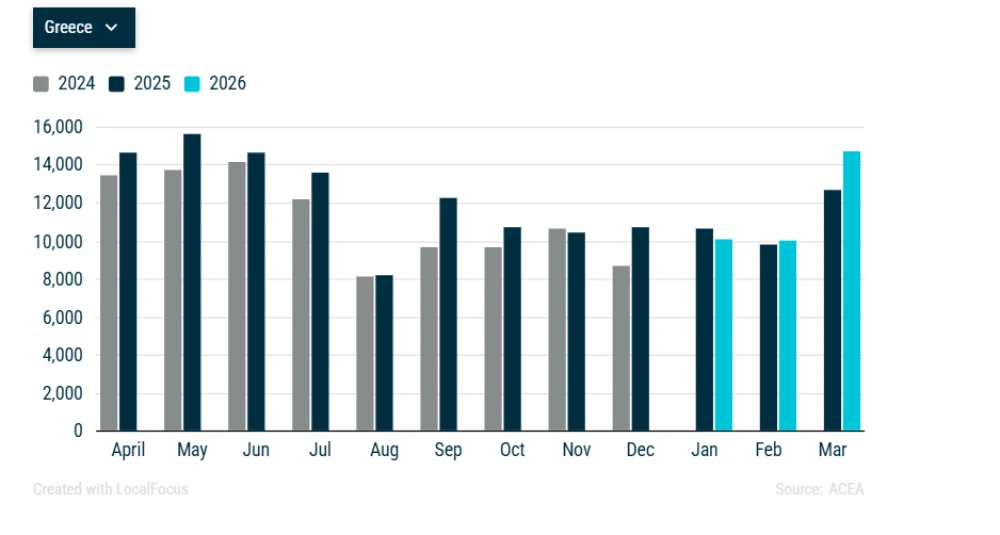
March 2026 confirmed the market’s momentum, according to Topspeed.gr, as registrations increased by 15.7% compared to the same month in 2025. On a quarterly basis, the rise was 4.9%, with a total of 34,812 new registrations.
The difference between the strong March and the milder first quarter shows that the market continues to be affected by circumstances, but the general direction remains positive.
The transition in terms of market, not ideology
What emerges from the data is not a sudden change in technology, but a gradual shift based on economic and practical criteria. Consumers are turning to solutions that reduce usage costs without requiring a drastic change in daily life. In this environment, aid policies act as an accelerator, not a constraint.
Market Size: Recovery with consolidation
The strong performance in March confirms that there is active demand in the market, which manifests itself when market conditions improve. The 15.7% increase shows that consumers return strongly when there is clarity and availability.
At the same time, the first quarter’s +4.9% reflects a more balanced picture. The market is no longer moving with sharp fluctuations, but with a gradual stabilisation, an element linked to the overall improvement in the economic environment.
Energy sources: The real centre of gravity
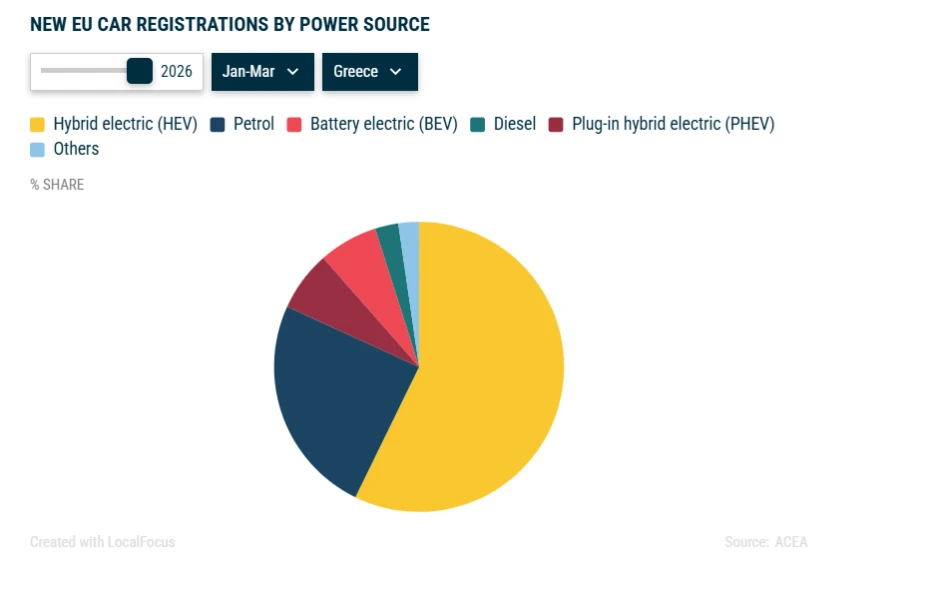
The essence of the change is in the engine mix.
Hybrids are now the mainstay of the market, up 34.7% in March and 23.3% in the quarter. This is an option that meets the needs of the Greek market, combining fuel economy, lower emissions and ease of use.
Electric cars are also moving upwards, up 31% in March and +13.6% in the quarter. Their growth is clear, but not explosive, indicating that their penetration remains linked to costs and infrastructure.
Reciprocally, plug-in hybrids are steadily strengthening, confirming their role as an intermediate solution for those who want to reduce consumption without being fully dependent on charging.
On the other hand, petrol and diesel continue their downward trend. The -24.4% drop in petrol in the quarter and the -26% drop in diesel confirms that the market is gradually moving away from traditional fuels.
The economic and political reading
This development cannot be disconnected from the policy framework that has been shaped in recent years. Incentives for cleaner forms of transport, combined with the gradual increase in the burden of polluting options, have had a substantial impact on market behaviour.
What is particularly important, however, is that the adjustment is being made in market terms. Consumers are not abandoning old technologies en masse, but are choosing solutions that suit them economically and practically. At this point, the balance achieved between different technologies shows that the transition is evolving realistically.
The real stakes
The Greek car market in 2026 is not heading towards a single technology, but towards a multi-level model where different solutions coexist. Hybrids have already taken the central role, electrics are gradually gaining strength, while internal combustion engines are receding without immediately disappearing.
The stakes for the next period are not to impose a specific technology, but to maintain a balance that allows the market to evolve without distortions. The track record so far shows that when policy creates a stable framework and targeted incentives, the market responds – not in leaps and bounds, but in steady and measurable steps.
And that, in the end, is perhaps the most essential conclusion: the transition is moving forward, but at the pace that the market itself imposes.


