

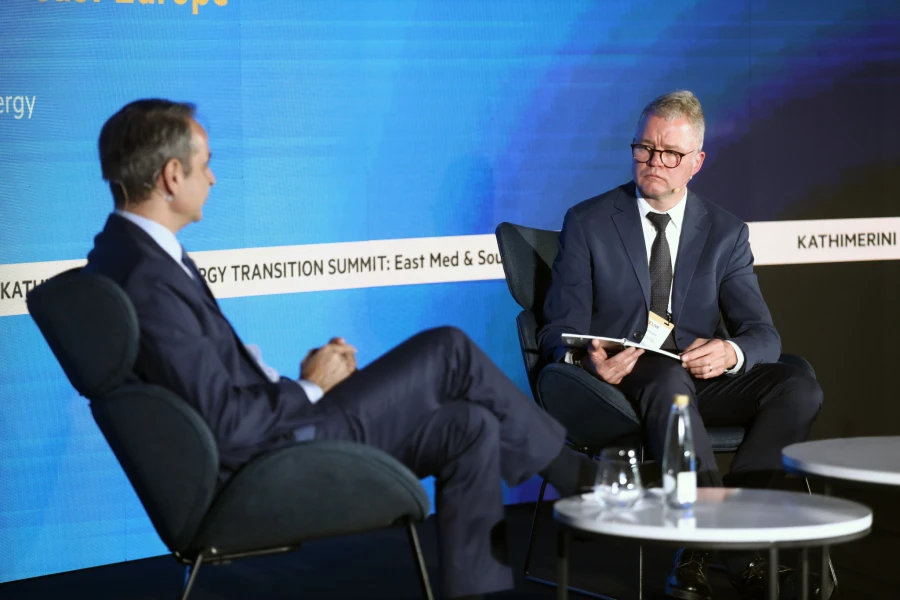
Developments in the US war with Iran was the first issue on which Kyriakos Mitsotakis in the conversation he had with Ben Hall, Europe Editor, of the Financial Times at the “Energy Transition Summit: East Med & Southeast Europe” conference.
“We are facing a period of great geopolitical and economic upheaval,” the prime minister said, noting that he could not predict what would happen and noting that the EU always supports a diplomatic solution.
“Iran cannot acquire a nuclear weapon and, of course, freedom of navigation in the Sea of Hormuz must be fully restored. I would like to place particular emphasis on the second point, because an extremely dangerous precedent is being set,” Mitsotakis stressed, explaining that these parameters will determine the final possible agreement between Iran and the United States.
“We must be able to prepare for a possible negative scenario: prolongation of the conflict, a significant increase in inflation, a decrease in growth rates and the need for all governments to support their citizens in a period of pressure,” the prime minister said.
He said Greece has fiscal space because it is achieving primary surpluses.
“We are one of the five European countries that have managed to do this. The countries that were in crisis have a much better fiscal picture today, but we understand that the possibilities at the national level are not unlimited. Protecting our economies and our citizens from a prolonged financial crisis must, I believe, be a responsibility and an issue that must be addressed immediately. Unfortunately, we have already experienced what happened in 2022, when gas prices soared, with dramatic consequences for energy markets,” he added.
At the same time, he said that what is happening today in the Hormuz Strait is another indication that we need to take energy security in Europe much more seriously.
“We have a policy on climate change; I am not sure we have an energy security policy. And unfortunately the two do not always go hand in hand,” he added.
“Every week that the Hormuz Strait remains closed adds further pressure to the global supply chain. There is a danger of accepting the status quo as something that is tolerable. I don’t think it is,” he continued, noting that “we almost forget about it because there are no intense military operations going on, but it is a very serious issue.” “I also understand – and I’m sure the president of the United States understands – that this is causing a lot of domestic pressure because of the price of gasoline. So he also has an incentive to put this deal at the top of the agenda, probably even in his discussions with President Xi,” he added, noting that China and the entire global economy is affected.
“We live in an interconnected world. We cannot believe that a serious disruption in the natural supply of oil and petroleum products will leave anyone unaffected,” he said.
The Prime Minister said Greece is a country fully self-sufficient in terms of fuel, including aviation fuel.
“We are major exporters of petroleum products.We have excellent refineries,” he said, adding that he believes deeply in the green transition and that when we reach climate neutrality, we will have taken a significant step in terms of our energy security.
“We may believe in Europe that we are done with fossil fuels, but fossil fuels are not yet done with Europe. We are now seeing it in the consequences. We don’t have a problem in terms of supply and we are exporting products to the rest of Europe. Of course there is concern about how this will affect flights. The tourist season has started very well, but nobody can make safe predictions. I think many people are delaying their bookings until the crisis is resolved. But I am still optimistic. I hope that in the next few weeks we will be able to resolve this crisis and I expect, as usual, a big wave of last-minute bookings,” he said.
On measures to support society, the Prime Minister said it was Greece that intervened on diesel as it affects the entire supply chain and directly feeds inflation.
“We also supported pensioners and families with children. We fully understand that the number one problem facing governments in Europe today – not just in Greece – is the cost of living.
In Europe we often talk a lot about competitiveness, and rightly so. But we need to explain that competitiveness is a prerequisite for dealing with the crisis of price competitiveness. We need higher wages,more productivity and more fiscal space,” the prime minister said.
He said that precision “is at the top of my agenda” and that at the same time “I need to ensure that the measures we are implementing do not exacerbate inflation and that they are targeted and temporary, which is exactly what we have done.”
Mitsotakis estimated that for the first time, probably later this year, Greece will not be the most indebted country in Europe.
“This is a political legacy for me and an obligation to future generations. We are not going to risk it. Everything we do will have to be within European rules. If we are talking about national borrowing, that is a completely different matter. If we are talking about European borrowing, then it must be directed towards very specific European priorities,” he stressed.
He said that the European budget does not currently meet European ambitions and that we must also mobilise private capital.
“If we want, for example, to be much more ambitious in defence – and for me defence is the predominantly European public good – then we should consider European borrowing for specific priority areas,” he said, adding: “I would not support a generalised European lending to deal with an economic crisis, but a targeted European lending could be on the table.”
In another point of the debate, Kyriakos Mitsotakis said that Greece and Italy have provided ships to protect freedom of navigation in the Red Sea.
“If Europe really wants to seriously address its role in this region of the world, then it must also provide the necessary resources. Greece has made it clear that if there is a peace agreement and a UN resolution calling for a peacekeeping force in the region, we will be ready to participate. We have an inherent interest in protecting freedom of navigation. We are a medium-sized open economy and a leading maritime power. Shipping is vital for our economy,” he said.
The prime minister also referred to the mining that will take place inGreek waters for deposits and how this is good for our country and for Europe, while stressing that we have lower electricity prices as we have developed renewable energy and have become an exporter.
“Greece could have 80% renewable energy, but theother 20% should be something else. We are not abandoning the green transition strategy. We are rapidly expanding energy storage capabilities. Storage is critical for Greece. Natural gas will remain with us for the foreseeable future. And we are not abandoning the renewable energy strategy. But if I can get it, I’d rather produce my own gas than pay for imports. This will make a huge difference to our public finances and an even bigger difference to our energy security,” he stressed.
Mitsotakis also said that we don’t have a real energy market in Europe but a fragmented energy market.
“We don’t have sufficient interconnections and we don’t treat electricity as a European resource. I have been a strong supporter of investment in networks and interconnection infrastructure,” he said, while referring to the Draghi report, he said that energy costs are at the top.
“We know that we are moving towards electricity and electrification in general. So we know we’re going to need more electricity. The price of electricity as a cost component for everything we do will become critical,” he added.
Referring to the use of nuclear energy, he said it is the only long-term alternative to natural gas for basic electricity generation.
“We have set up a working group to look at the future of nuclear energy policy in Greece. This is a 10-year plan; it is not something that can be done immediately.
No decision has been made. But for a country that once panicked at the mere mention of the word “nuclear”, the fact that we can now have this discussion with arguments for and against is a great progress,”
.


