

The Minister of Rural Development stresses the transition from subsidies to investments that add value and support sustainable rural development in Greece.
At a time when the Greek agricultural economy is constantly seeking a new orientation and more sustainable development tools, Margaritis Schinas highlights the need for a deep restructuring of the production model. On the occasion of his visit to three model agricultural units in the Regional Unity of Thessaloniki, he focused on the transition from the traditional support system to a framework that emphasises investment, innovation and the creation of added value. This approach, he stressed, links European financing and the Recovery Fund to real production, strengthening the competitiveness of the primary sector and creating conditions for long-term development for rural communities.
“The bet for agricultural production is to move from a system of payments to a system of creating surplus value“, said Minister of Rural Development and Food, Margaritis Schinas, who visited three model units of the agricultural sector, located in the Regional Unit of Thessaloniki, which are pioneers of their kind and have been included in the Recovery Fund.
Negotiations for the new CAP continue
The Minister visited the cattle unit “Agrofarm Lagada”, the fruit packing business “PROTO” in Kalochori and the drying plants – rice warehouses of the 2nd Agricultural Cooperative of Halastra, where he toured the investments, talked to the responsible persons and was informed about their financial figures.
“These three projects are typical investment programmes where we combine the traditional financial instruments of agriculture with the Recovery Fund, so they are important,” Schinas told APE-MPA.
As regards the debate that has been opened on what will happen after the expiry of the Recovery Fund, the Minister of Rural Development and Food stressed that the negotiation for the new CAP continues, the model of Greek agriculture must be changed and it must be directed towards investments linked to the creation of added value.
“It also opens a page now for the future. After the Recovery Fund, we need to think in the new CAP how this kind of investment, with private capital and support from Europe, will work, that is, keep rural communities close to these investments. That is what is at stake. Farmers must continue to live and create around these investments”, Schinas said and continued: “All three projects I visited are built in areas that are linked to production and multiply added value.
These investments will stay because they are not linked to payments, as is the classic model of Greek agriculture. They are investments linked to added value, that is, through these investments added value is produced in production.”
Lagada Farm
The cattle farm “Lagada Farm” is owned by the four Kefalas brothers. Its turnover in 2025 was 4.8 million euros and it raises 400 dairy cows and 400 breeding calves.
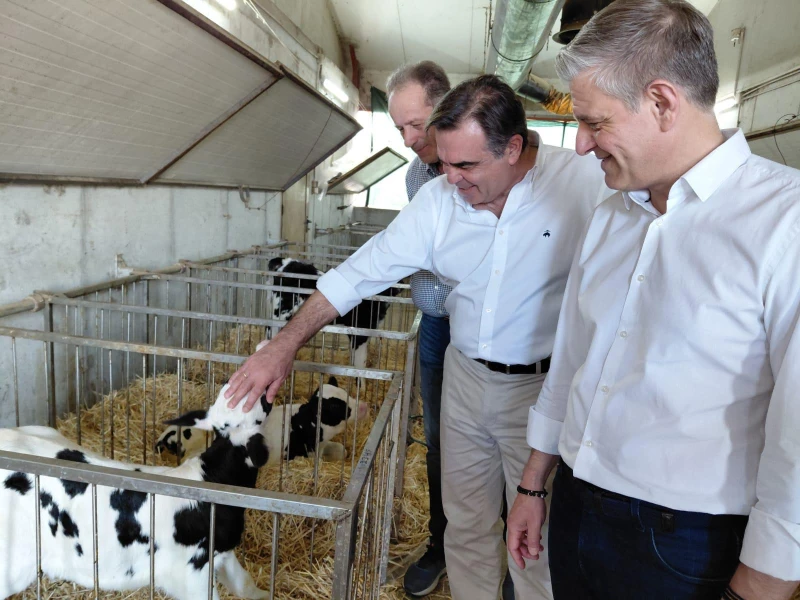
According to George Kefalas, it is perhaps the only agricultural enterprise in Greece that fully implements a circular economy system. They cultivate 3,300 acres for feed production, feed their animals, produce cow’s milk and beef for the consumer, and the wastewater goes to a one megawatt biogas consortium plant that processes 80,000 to 100,000 tons of organic agricultural waste annually. This is used to produce energy for the power utility and 80,000 tonnes of organic soil conditioner per year, which is used to fertilise 8,000 hectares of arable land each year.
The productivity of the plant is 11,500 litres of milk per cow per year, ranking it among the most productive in Europe.
It is the only one in Greece that has managed to produce embryos from its own animals which are used to breed other animals that are less productive.
It has a special section where animals born sick go and stay until they are healthy. In this way, mortality has been reduced to practically 0%.
It maintains 20 other small businesses by satellite and employs a total of 200 people.
The recovery fund is financing with 1,500,000 euros the construction of a fattening unit, the building of which will be ready in June. The aim is to create a new breeding unit of 800 100% Greek calves that will produce 350 tonnes of meat a year, with a turnover of 4,000,000 euros. “This unit is the epitome of the circular economy and production,” said Thessaloniki regional governor Konstantinos Youtikas.
It is noted that Central Macedonia produces 36% of the livestock in Greece and 40% of the agricultural GDP.
Packing plant “PROTO”
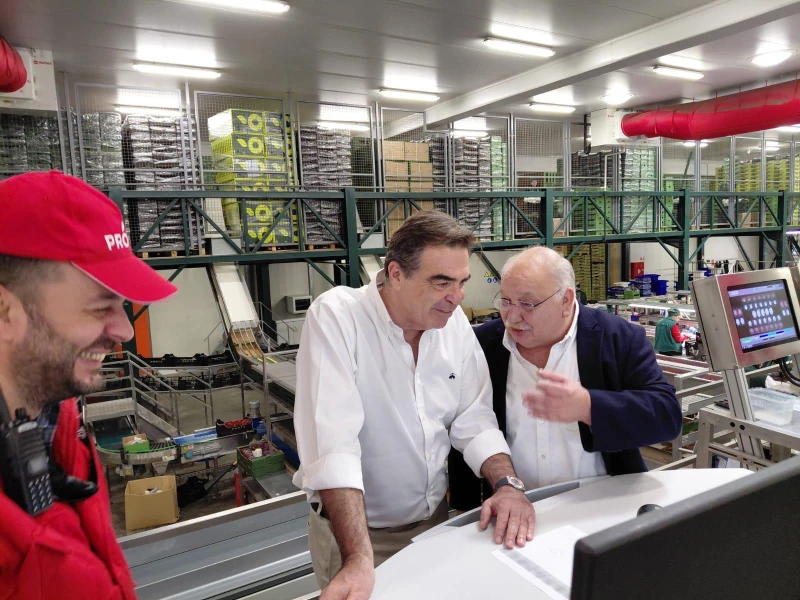
The fruit packing plant “PROTO” in Kalochori, with a life of 98 years, is the largest in Europe in terms of green kiwis and cherries, as it processes 32.000,000 kilos of green kiwis in six months, as its owner Nikos Protofanousis told us.
From 20,000,000 euros in 2015, its turnover increased to 80,000 euros in 2025.000 euros and is the largest company of its kind by turnover.
In the period 2017-2025, investments of 41,000,000 euros were made.
Packaging kiwifruit, cherries and grapes and exporting to the US, Europe, Canada, Brazil, South Africa, Brazil, South Africa, China and the USA. Africa, Middle East, England, India, Thailand and other countries.
The Recovery Fund financed an investment of 5,000,000 euros for the creation of new cold storage facilities.
Rice drying and storage facilities
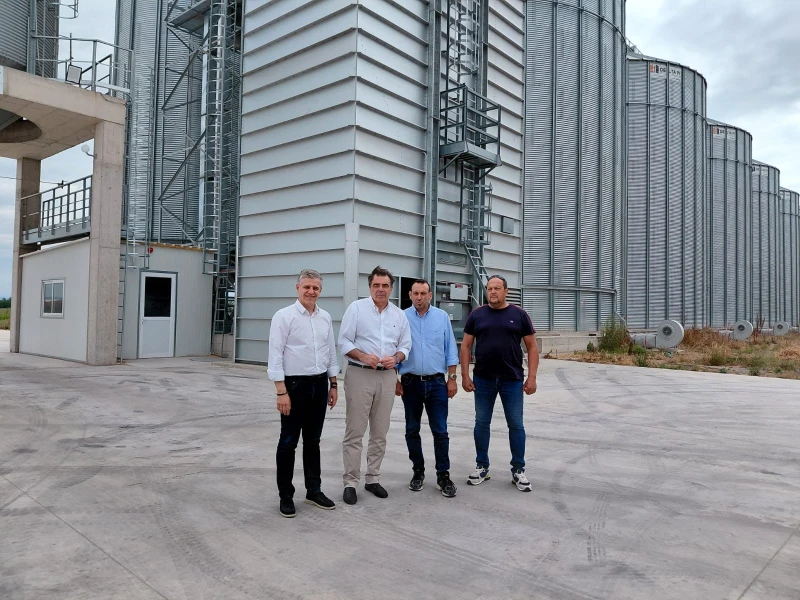
In the premises of the 2nd Agricultural Cooperative of Halastra, Mr. Schinas was welcomed by its president Vassilis Koukourikis, who informed him that 40-50% of the rice production nationwide is stored in Halastra.
The investment financed by the Recovery Fund is the construction of 7 new silos, totaling 3,500,000 euros, which will be added to the 42 existing ones.
The president of the cooperative also referred to the problems caused by the low price of rice. In all three visits, the Minister of Rural Development and Food was accompanied by the deputy regional governor of Thessaloniki, Konstantinos Youtikas.


