

At Café of the National Archaeological Museum on Wednesday, June 17, 2026, the interdisciplinary by Stratigoula Giannikopoulou and Panagiotis Marinis “Sculpting,” curated by Iris Kritikou and organized by Emilia Kougia.
Man is an animal that uses tools. Without tools he is nothing; with tools he is everything – Thomas Carlyle
Stone tools are the oldest type of tool produced by humans as a primary means of survival as early as the Paleolithic era, often symbolically accompanying him as a funerary and symbolic grave offering to his final resting place.
With the desire for an active dialogue between the material and the symbols of their subject matter, Stratigoula Giannikopoulou and Panagiotis Marinis come together artistically for the first time, exploring form, timeless symbolism, and the secret language of tools.
Creating a moving alphabet of existence and skillfully capturing the transformation of an artifact into a work of art of high aesthetic and meaning.
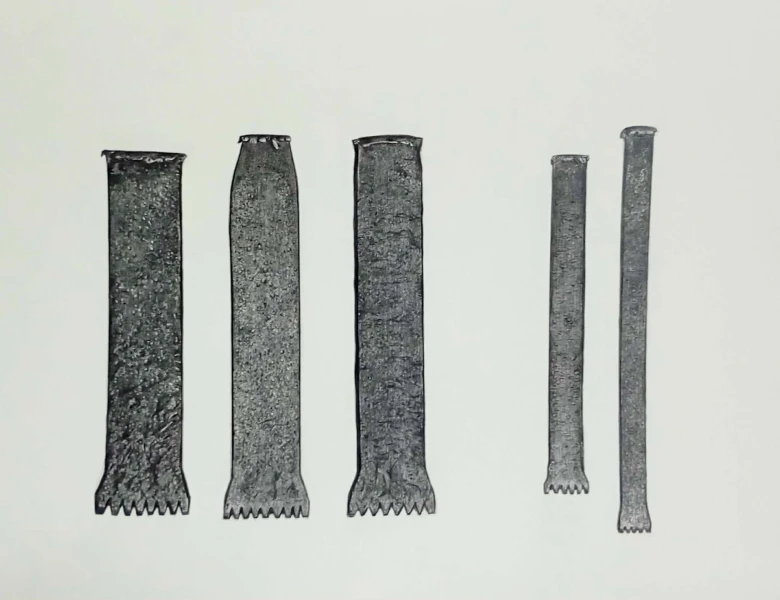
Hailing from Lagadia in Arcadia and a family of renowned Lagadian stonemasons, Stratigoula Giannikopoulou creates a fascinating series, drawing with pencil and painstaking precision portraits of handmade local tools from the 19th and the 20th century, whose appearance, repetitive sound, use, and memory she grew up with. “Childhood summers among the rocks and stories of stonemasons, with stone marking your life and constantly reappearing in your works,” she notes.
Hailing from Aegina, the self-taught sculptor Panagiotis Marinis, a leading continuator of his island’s stone-carving tradition, is best known for his primitive stone masks.
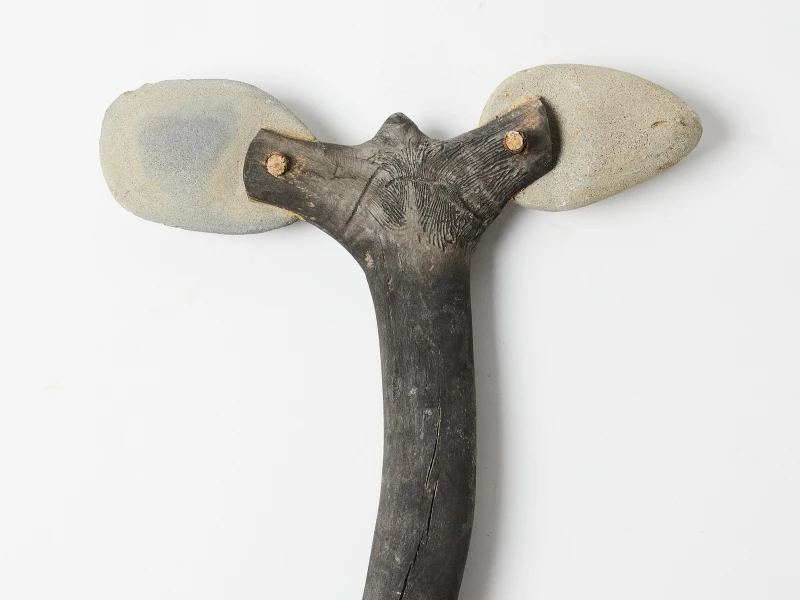
The collection of stone tools he presents here—hammers, chisels, spirit levels, and other objects suspended against a white background—constitutes, as a moving visual entity in its own right, the natural continuation of the theme that preoccupies him and, at the same time, “the true starting point of his inspiration and the handmade approach to his sculptural creation,” he notes.
The exhibition curator, archaeologist and art historian Iris Kritikou, notes:
“The works of Stratigoula Giannikopoulou, having already been partially presented as a theme at the Lagadia birthday celebration, alongside remnants of craftsmen’s diaries and old tools, faithfully accurate yet simultaneously timeless and abstract black-and-white offerings of memory, masterfully drawn in pencil on paper, emerge from the stone of the Arcadian land, preserving a centuries-old craftsmanship and hover as emotional votive offerings of labor into infinity.
Symbolically preserving the memory, the life, the journey, and the art of master craftsmen who shaped the stone literally and figuratively, digging, chiseling, bridging, and building paths and houses, public buildings, squares, and bridges, churches and schools that stand the test of time and continue, with their wise craftsmanship and unadorned beauty, to captivate the eye and the soul.
Always starting with a stone that is unquestionably “right,” which in some inexplicably predestined way finds its way into his hands, Panagiotis Marinis unearths dark and gray matrices from the soil of Aegina and the depths of the sea, giving them new life. In recent years, he has focused not only on the sculptural, representational result but also on the laborious process of carving itself and, consequently, on the stone tools he uses, which he crafts himself.
The first examples of this exploration were initially presented at the Diachronic Museum of Larissa, in dialogue with the original stone tools from the Neolithic and Bronze Ages in its collections. With perseverance, ingenuity, and instinctive economy, Panagiotis Marinis creates with his own hands original stone artifacts: self-contained stone tools of various sizes, potential uses, and raw materials, which, resting as a whole on his workshop bench, gradually acquire a new, rare, and self-contained value. Wide grinding surfaces, chisels, blades and other cutting tools, knives, drills, scrapers, spears, and lances are crafted using a simple yet ingenious methodology that yields a polished result.
The current coexistence of these two distinguished visual artists fosters an fascinating dialogue both between them and with the corresponding artifacts in the collections of the National Archaeological Museum, which, more than any other object, speak to humanity’s timeless struggle for survival as well as its welling need for art and creation”.


