

In 2025, Greece recorded one of the top performances in the European Union, with 97.1% of bathing water classified as “excellent” quality and no site classified as “poor” quality.
Consistently at the top in Europe
From the Atlantic to the Mediterranean, the vast majority of European bathing waters met the strictest standards of “excellent” quality in 2025, according to the annual report by the European Environment Agency (EEA) and the European Commission. The assessment was based on monitoring more than 22,200 bathing sites in the 27 EU member states, as well as in Albania and Switzerland.
At the EU level, 85% of bathing sites were classified as “excellent” quality, while 96% met at least the minimum requirements of the relevant Directive. Only 1.5% were classified as “poor” quality, with the overall picture remaining essentially unchanged from the previous year.
coastal waters continued to perform better than inland waters, as 88% of marine sites were rated as “excellent,” compared to 78% of rivers and lakes. At the top of the rankings were Cyprus, Greece, Bulgaria, and Austria, with rates above 95%.
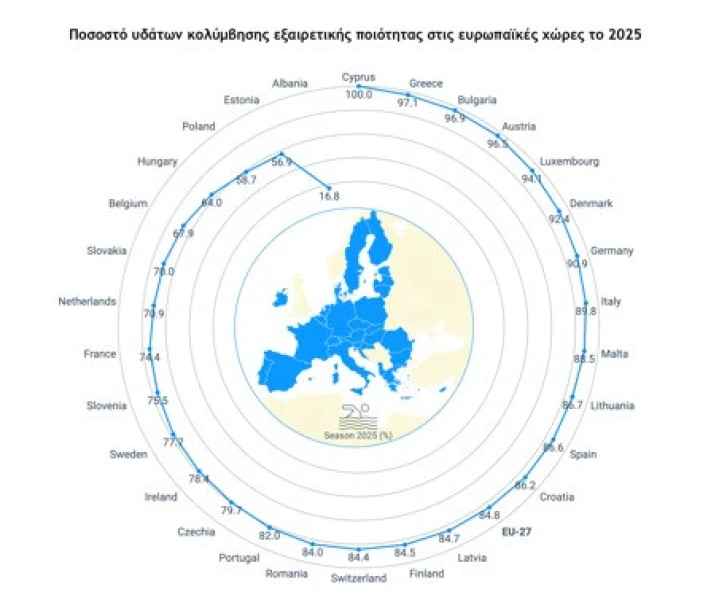
Greece in Numbers
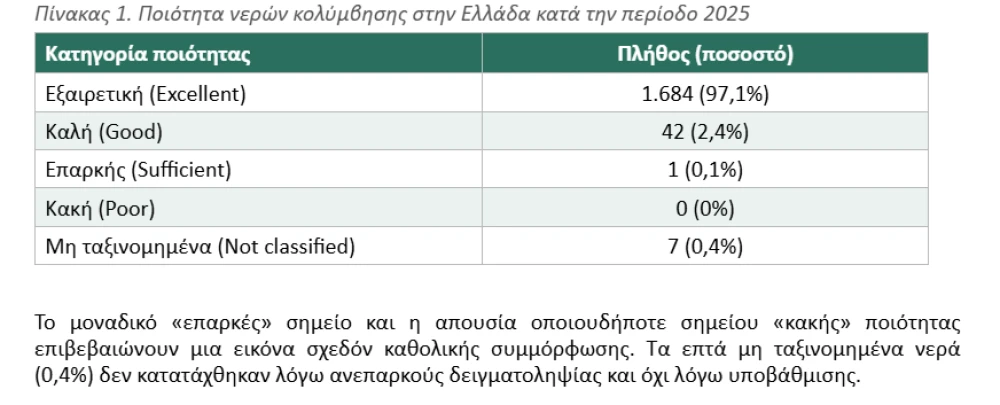
Greece is once again among the leading participants in this year’s European exhibition. Of the 1,734 recognized swimming waters, of which 1,733 are coastal and just one is inland, 97.1% were classified as “excellent” quality.
At the same time, 99.6% of Greek waters meet at least the minimum standards of the Directive, as they are rated “sufficient” or better. During 2025, a total of 10,477 samples were collected and analyzed.
A particularly positive finding is that no sites were classified as “poor”, while only one site was rated as “sufficient.” The seven unclassified water bodies account for 0.4% of the total and were not assessed due to insufficient sampling, not due to a decline in quality.
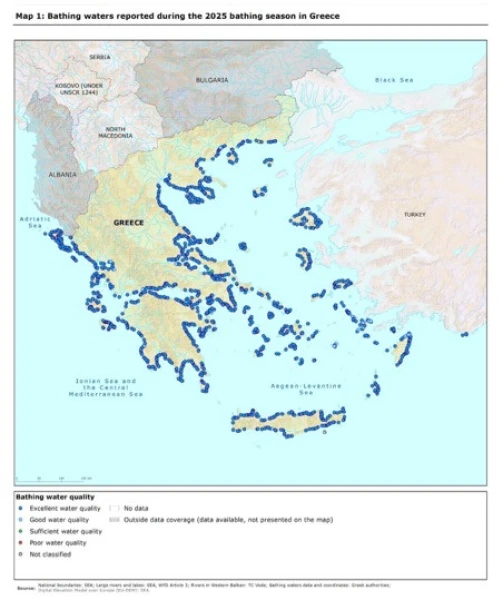
How is the assessment conducted
The classification of bathing waters is based on two key microbiological indicators, Escherichia coli and enterococci, which are indicators of fecal contamination and potential risks to public health.
In 2025, six new bathing sites were designated for the first time, while two were removed from the list. At the same time, 1,733 Greek water bodies (a percentage of 99.9%) fully met monitoring requirements, with sampling prior to the start of the season and at least four samples per bathing season.
During the four-year period 2022–2025, a total of 1,677 sites (96.7%) were continuously monitored, 56 sites (3.2%) had been recently identified, and only one site had a monitoring gap.
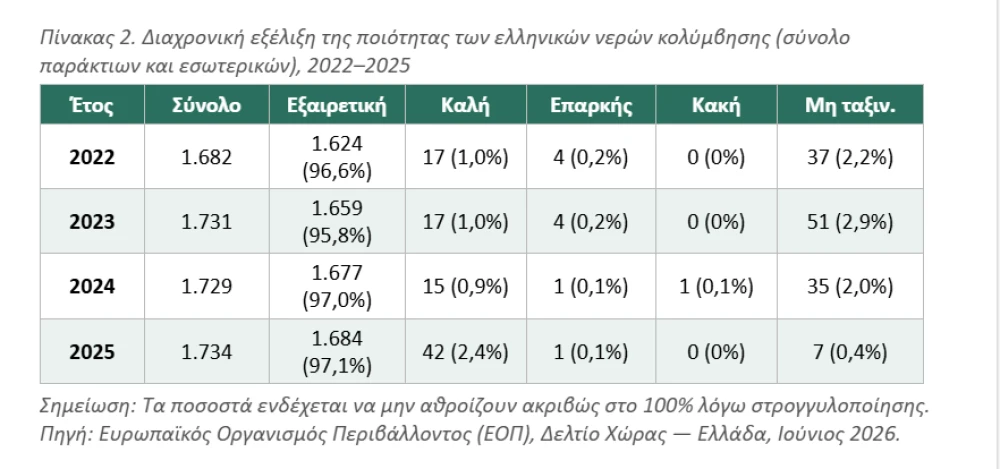
What the long-term trend shows
The long-term trend confirms the consistently high quality of Greek waters. Over the last four years, the percentage of sites of “excellent” quality has remained consistently above 95.8%, while the number of unclassified sites decreased significantly, from 51 in 2023 to just 7 in 2025.
The report notes that the Bathing Water Directive complements a broader European framework for water protection, which includes the Water Framework Directive, the Directive, the Urban Wastewater Treatment Directive, the Nitrates Directive, and the Marine Strategy Framework Directive.
However, the EEA points out that the assessment concerns exclusively microbiological parameters and does not cover other potential chemical pollutants, such as pesticides, pharmaceuticals, or nutrients. Despite the positive picture, maintaining healthy and resilient aquatic ecosystems requires continuous progress in the face of the challenges of pollution and climate change.
Commenting on the results, the Commissioner for Environment, Water Resilience, and a Competitive Circular Economy, Gesika Rosval, emphasized that the data demonstrate the importance of European environmental legislation and long-term investments in wastewater treatment. For her part, the Executive Director of EEA, Leena Ila-Mononen, emphasized that consistent enforcement of the rules has made the vast majority of European waters safe for swimming and more resilient to the effects of climate change.


