

The Greek car market remains positive in 2026, with increase in registrations and a gradual shift toward modern propulsion technology.
The Greek automotive market continues to demonstrate resilience and stability amid an international environment that remains fraught with challenges. Geopolitical tensions, disruptions in global trade, the uncertainty that continues to characterize Europe’s major economies and the pressures on household disposable income were not enough to halt the positive trend in registrations of new cars in Greece. Data from the European Automobile Manufacturers’ Association (ACEA) for May 2026 show a market that continues to grow, albeit at a slower pace compared to previous years, confirming that the Greek economy is maintaining its resilience and that consumer and business confidence remains strong. At the same time, the fleet renewal and the gradual penetration of newer propulsion technologies reflect a deeper shift linked both to citizens’ choices as well as with the broader policy framework implemented in recent years to modernize transportation.
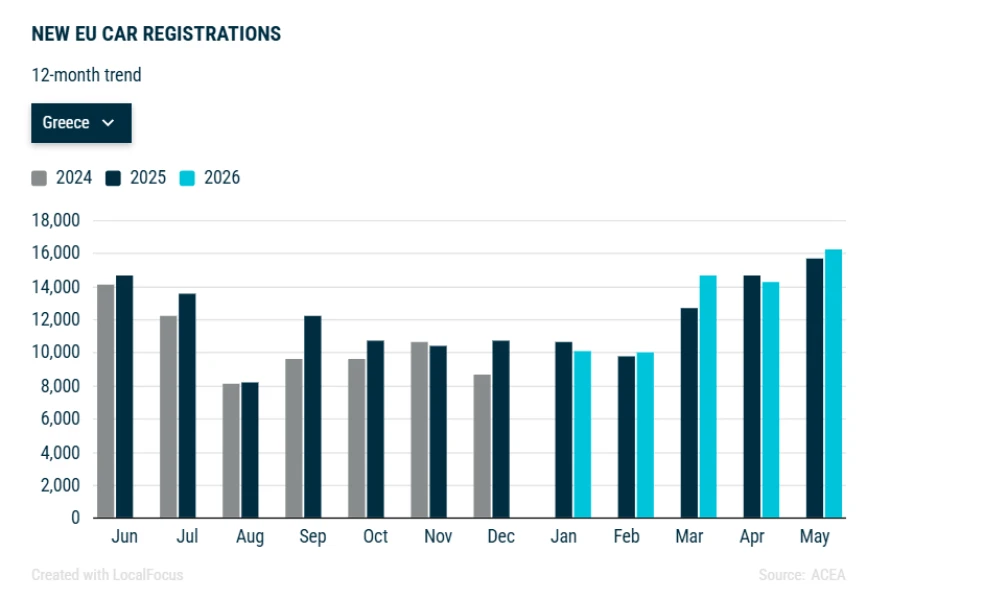
The overall market outlook remains positive, as shown in the analysis by topspeed.gr. In May 2026, 16,242 new passenger cars were registered, compared to 15,670 in the same month of 2025, marking a 3.7% increase. Similarly, during the period from January to May , registrations totaled 65,297 units, compared to 63,515 during the corresponding five-month period of the previous year, representing a 2.8% increase. This performance is particularly significant given the current climate of uncertainty prevailing internationally. Greece is managing to maintain an upward trajectory in a sector that serves as a strong indicator of economic activity, investor confidence , and consumer behavior.
However, beyond the overall figures, the shift in the market’s composition is of particular interest. Greek consumers are not limited to buying more cars, but are turning increasingly toward newer propulsion technologies, seeking better energy efficiency, lower operating costs, and greater environmental compatibility. This picture reflects not only developments in the automotive industry but also the gradual maturation of a market that is steadily modernizing. The first five months of 2026 thus offer a clear picture of the trends shaping the future of the Greek automotive industry.
Hybrids: The market’s leading player
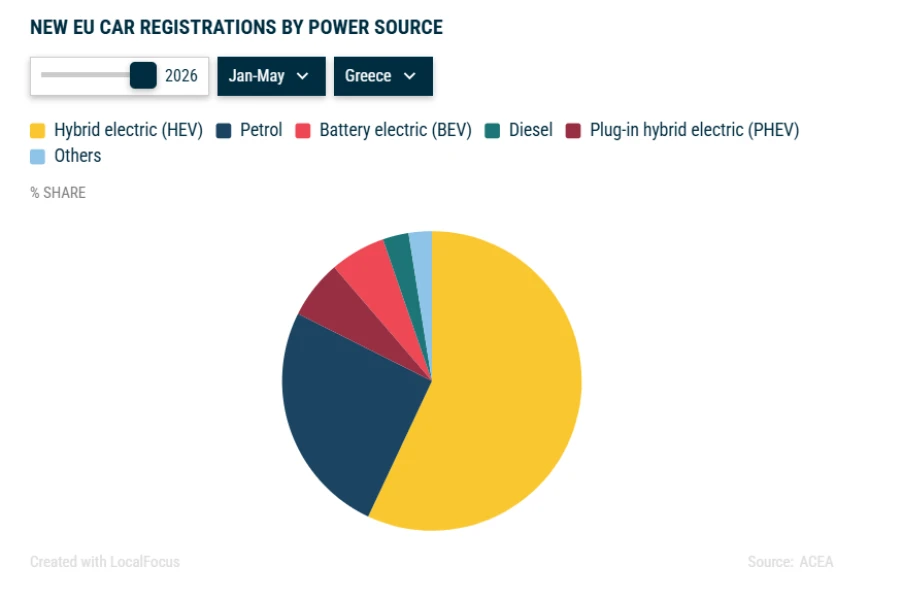
The most powerful message from the 2026 data comes from hybrid cars. This category has become the undisputed leader of the Greek market, recording impressive growth in its market share. In May, 9,117 hybrid vehicles were registered, a 22.2% increase compared to the same month last year. Even more striking is the picture for the first five months, during which registrations reached 37,243 units, representing a 21.5% increase.
In practice, nearly six out of ten new cars registered in Greece during the first five months of 2026 were hybrids. This trend demonstrates that consumers are choosing technologies that combine fuel efficiency, low emissions, and convenience in everyday life. Without requiring changes to charging habits or long-distance travel, hybrids offer a solution that effectively meets the needs of the Greek market.
Their dominance is also an indication that fleet renewal is taking place in a way that allows for the adoption of newer technologies on a large scale. In a country that still has one of the oldest vehicle fleets in Europe, this trend takes on particular significance for road safety, energy efficiency, and the overall environmental performance of transportation.
Electric Vehicles: Gradual growth of a developing market
Electric vehicles continue to gain ground in Greece, though it has not yet reached the penetration rates seen in several European countries. In May, 951 all-electric cars were registered, marking a 27.5% increase, while registrations for the first five months of the year reached 3,938 units, up 16%.
This trend indicates that electric vehicles are gradually gaining a larger foothold in the country. The expansion of the charging network, the introduction of more models to the market, and improvements in the technical specifications of electric cars are creating the conditions for further growth in this segment in the coming years.
At the same time, the presence of electric vehicles is linked to a broader effort to modernize transportation, which includes investments in infrastructure, the development of new services, and the gradual adaptation of urban and intercity transportation to the demands of the new era. The increase in registrations reflects that an ever-larger segment of the market is becoming familiar with this technology.
Plug-in Hybrid: The bridge between two worlds
Plug-in hybrid models also continue to play a significant role. Although there was a slight decline in registrations in May, the picture for the first five months of the year remains positive, with 4,134 new registrations and a 5.5% increase.
This category continues to attract buyers who want to take advantage of the benefits of electric propulsion for their daily commutes, while retaining the ability to cover long distances without relying on public charging infrastructure.
The steady presence of plug-in hybrids indicates that the market is not moving in a single direction. Instead, a multi-technology environment is taking shape where different solutions coexist and serve different needs, depending on each driver’s profile and the vehicle’s usage conditions.
Gasoline: The Gradual Decline of the Traditional Choice
The largest decline in 2026 was recorded among gasoline-powered cars. In May, registrations totaled 4,198 units, a 23.4% decrease, while 16,555 registrations were recorded in the first five months of the year, a 24.6% decrease.
This trend does not mean that gasoline is ceasing to be a key pillar of the market. It remains the second-largest category in absolute numbers and continues to be the choice for thousands of drivers. However, the gradual shift of a significant portion of buyers toward hybrid and other technologies is causing its market share to shrink.
This shift is a prime example of how the market is changing. Consumers now evaluate the cost of ownership, energy efficiency, and technological capabilities of new vehicles differently, leading to a more diverse landscape than in the past.
Diesel: A Limited but Tangible Presence
Diesel continues to maintain a limited presence in the Greek market, though it has not disappeared. Despite the significant increase recorded in May, the category’s overall footprint remains small, with just 1,826 registrations in the first five months.
This trend confirms that the diesel market has entered a period of maturation and gradual contraction. Nevertheless, it continues to meet specific needs, primarily those of professionals and drivers who cover long distances annually.
The limited but steady presence of diesel demonstrates that the transition to new forms of mobility is not happening abruptly, but rather through a process of adaptation that allows different technologies to coexist for several more years.
The Big Picture Behind the Numbers
The first five months of 2026 confirm that the Greek automotive market remains on a growth trajectory while also improving in quality. The increase in registrations is a sign that economic activity is maintaining its momentum, while the gradual renewal of the fleet is helping to improve energy efficiency and traffic safety.
The dominance of hybrids, the rise of electric vehicles, and the steady presence of plug-in hybrids show that the Greek market is adapting to the new reality without drastic upheavals and without relying on a single technological option. This is a transition that is unfolding with realism and balance.
If current trends continue, 2026 is expected to close on a positive note in terms of both market volume and fleet modernization. Amid a climate of international uncertainty, this picture serves as yet another indication that the Greek economy is resilient, while investments, infrastructure, and public confidence continue to underpin the country’s transition to a new era of mobility.


