

There’s an old rule in politics: when the facts don’t suit you, you invent a myth that sounds plausible. That’s more or less how the latest “success” of social media came about: that Greece is supposedly giving away cheap electricity to Bulgaria at noon and buys it back at exorbitant prices in the evening.
It sounds good as a slogan. Except that the electricity market operates based on price data and not on slogans.
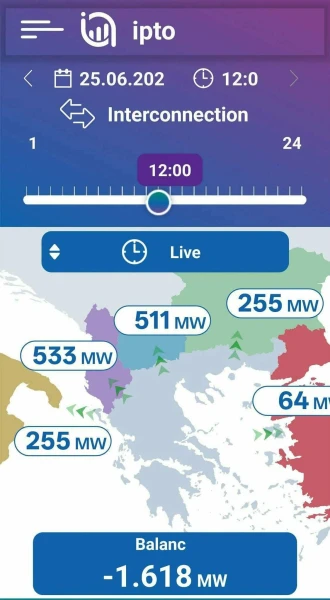
The data from ENTSO-E and the Hellenic Energy Exchange, presented by the Deputy Minister of Energy Nikos Tsafos, do not leave much room for creative interpretation. Greece is a net exporter of electricity to Bulgaria for most of the year, accounting for approximately 84% of the hours. And this applies not only to midday hours of high renewable energy production but also to a large portion of the evening hours, when net exports continue to exceed 1 GW.
Even more revealing is the data on prices. The Greek wholesale price is the same as or lower than the Bulgarian price for almost the entire year—approximately 98% of the time. Bulgaria is cheaper in only 2% of the hours. The oft-repeated claim that “we sell cheaply and buy expensively” is simply not supported by the numbers.
From the market… to the polls
But the interest isn’t limited to the electricity market. It also lies in politics.
It is no coincidence that the revival of the narrative regarding “return of lignite” is accompanied by the high-profile public presence of individuals seeking new political roles in the local communities of Western Macedonia. Former union leaders, who for years invested politically in defending the lignite era, are reappearing as defenders of a model that the economy itself has abandoned.
The reality is far more prosaic. With carbon dioxide emission allowances trading at particularly high levels, the cost of generating electricity from lignite is becoming prohibitive. The cost of emissions alone is enough to make many lignite-fired power plants unprofitable, even before operating expenses, maintenance, and payroll are factored in.
Simply put, lignite is not being phased out because of some ideological obsession, but because it is not financially viable.
The Day After
At the same time, the discussion in Western Macedonia has already shifted. The Public Power Corporation (PPC) is moving forward with a 5.75 billion euro investment program, which includes large solar farms, energy storage projects, and the creation of a large data center on the site of the Agios Dimitrios Thermal Power Plant, with the aim of transforming the region into an energy and digital hub.
It is obvious that this transition is causing upheaval, but anxiety about a region’s future is one thing, and the construction of simplistic political narratives is quite another.
In energy, as in the economy, the numbers have a drawback for those who invest in myths: they are difficult to tailor to pre-election needs. And no matter how hard some people try to turn the kilowatt-hour into a campaign slogan, market reality remains more stubborn than petty politics.


