

Initial estimates for the cutoff scores of the national exams for university programs show minor changes, an increase in Polytechnic schools, slight fluctuations in Medical schools, and variations in the 4th Field.
The announcement of the scores for the 2026 Panhellenic Exams and the statistical data by the Ministry of Education provides an initial picture of the trend in admission thresholds, though it does not allow for definitive conclusions. Educational analysts point out that the final picture will be shaped by the weighting coefficients, the Minimum Admission Threshold (MAT), and the candidates’ choices on the computerized application form.
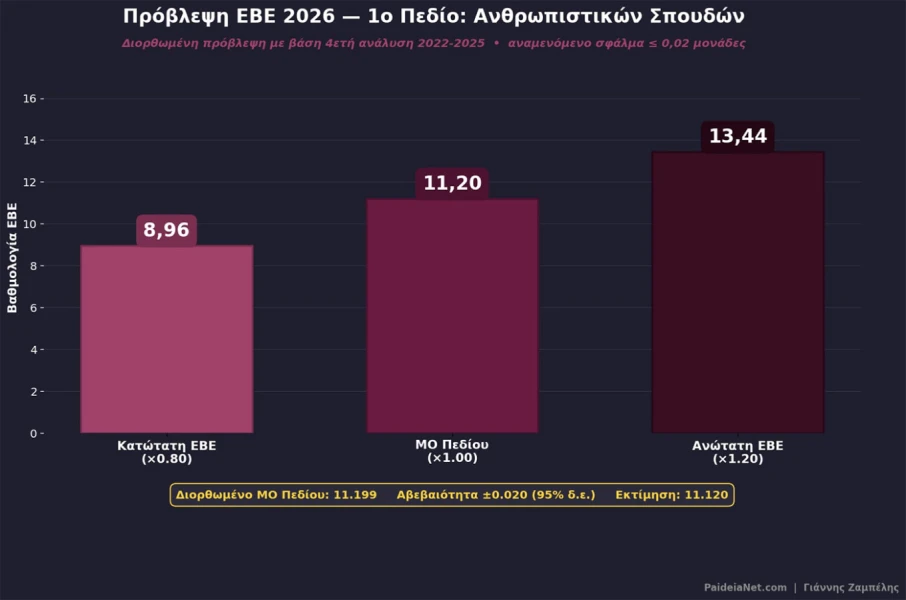
1st Field – Limited changes in top-ranked schools
In the 1st Academic Field of Humanities, Law, and Social Sciences, the performance of top-scoring students shows minor variations compared to 2025. Modern Greek Language shows a slight improvement, Ancient Greek has seen a slight decline, while a better picture is observed in History and, to a lesser extent, in Latin.
Based on the available data, no significant changes are expected in the admission requirements of most schools in this field. In Law Schools, limited variations cannot be ruled out, as the weighting of Ancient Greek plays a decisive role.
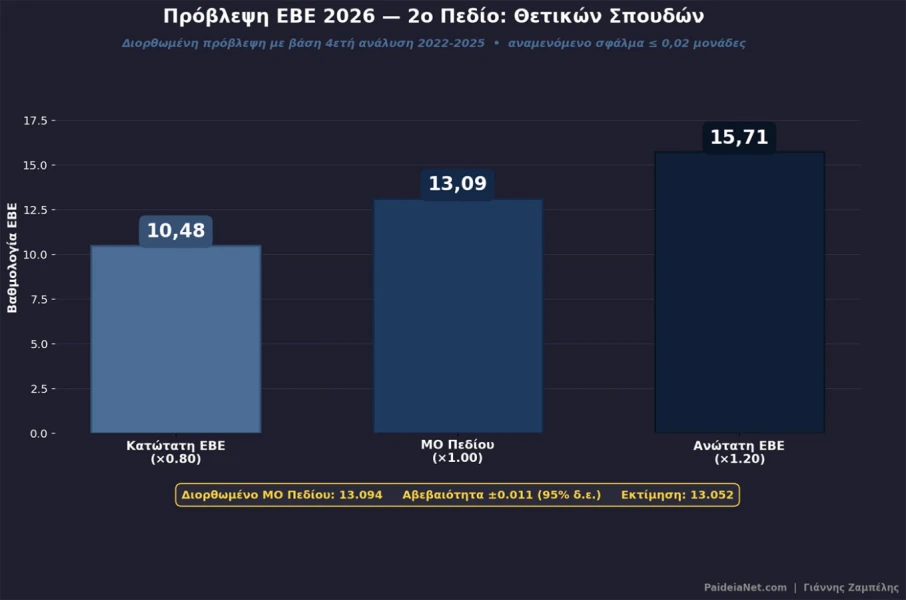
2nd Field – Upward Trends in Polytechnic Schools
In the 2nd Scientific Field of Natural and Technological Sciences, high scores are rising in Modern Greek, Mathematics, and Chemistry, while the greatest improvement is seen in Physics.
Since Mathematics and Physics carry greater weight in most engineering departments, initial estimates point to an upward trend in admission scores for several programs. However, a uniform increase across all schools is not expected, as applicants’ preferences will have a decisive impact on the final outcome.
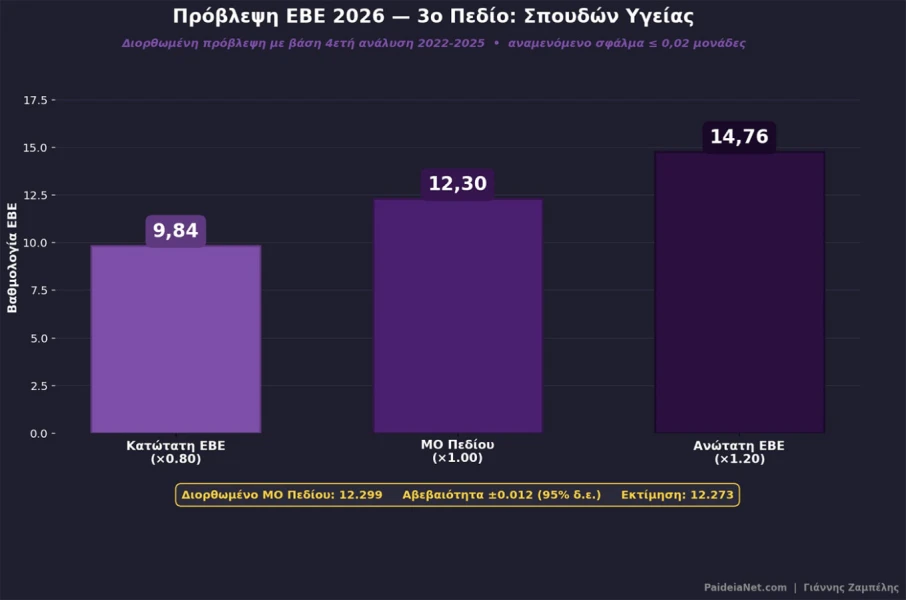
3rd and 4th Fields – Mild increase in Medical Sciences, mixed picture in Computer Science
In the 3rd Scientific Field, Health and Life Sciences, there has been a significant increase in high scores in Physics, a slight improvement in Modern Greek Language, but a decline in Chemistry and an even greater decline in Biology.
This picture leads to the assessment that medical schools and, more generally, schools in this field will experience minor fluctuations, with the overall trend pointing toward a modest increase.
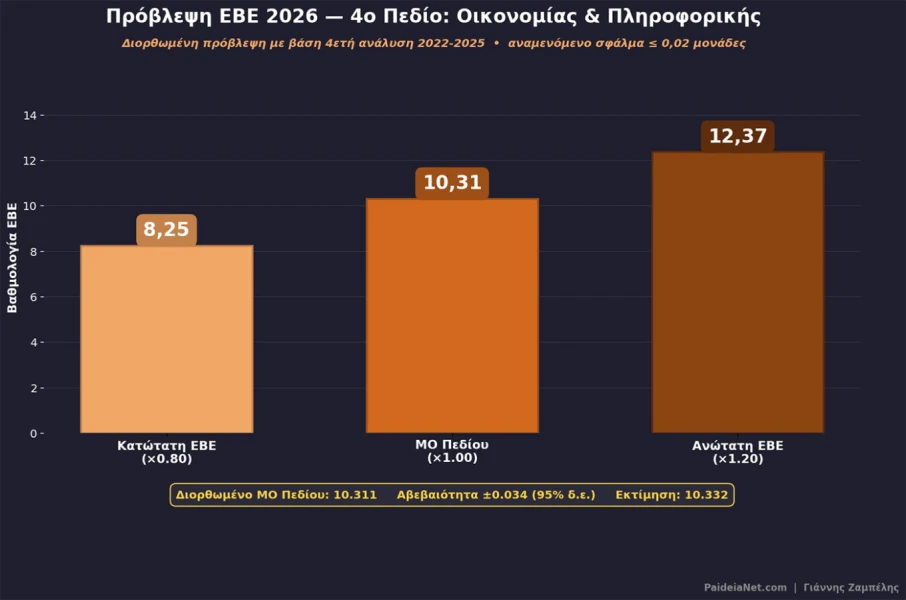
In the 4th Scientific Field, Economics and Computer Science, the picture is mixed. Modern Greek Language and Mathematics show a marginal improvement, Computer Science remains at nearly the same levels, while Economics has seen a noticeable drop in high scores.
As a result, the admission thresholds are expected to vary from department to department, with no single trend emerging across the entire field.
Final Estimates – Computerized Counting Will Be Decisive
According to initial analyses, the 2nd Scientific Field is most likely to see upward shifts, particularly in engineering and science departments. In Field 1, changes are expected to be limited, in Field 3, minor fluctuations are expected in health-related schools, while in Field 4, the picture will vary depending on the department.
Educational analysts estimate that the Minimum Admission Scores (EBE) will be close to 2025 levels, with slight variations among the four academic fields.
At the same time, they recommend that applicants fill out the computerized application form based on their actual preferences rather than predictions about the admission thresholds, as candidates’ final choices continue to be a decisive factor in shaping the results.


