

The President of the Republic, Constantine Tasoulas, hosted a dinner tonight (20/04) at the Presidential Palace in honour of President of the Republic of Estonia Alar Karis and the delegation accompanying him during his official visit to Greece.
Addressing his Estonian counterpart, Mr Tasoulas said that his visit to our country reflects the bonds of friendship that link the two peoples and confirms the high level of cooperation between our countries in all areas.
As he stressed, “Greece and Estonia, although geographically distant, share common values, principles and goals. Our two countries are located at the north-eastern and south-eastern corners of Europe, and they are concerned on a daily basis with the security, stability and prosperity not only of their neighbourhood, but also of our common European home”.He added that “the historical path of our peoples shows that national existence and freedom are not given away but are conquered, with the weapons of language, unity and faith in the common goal”.
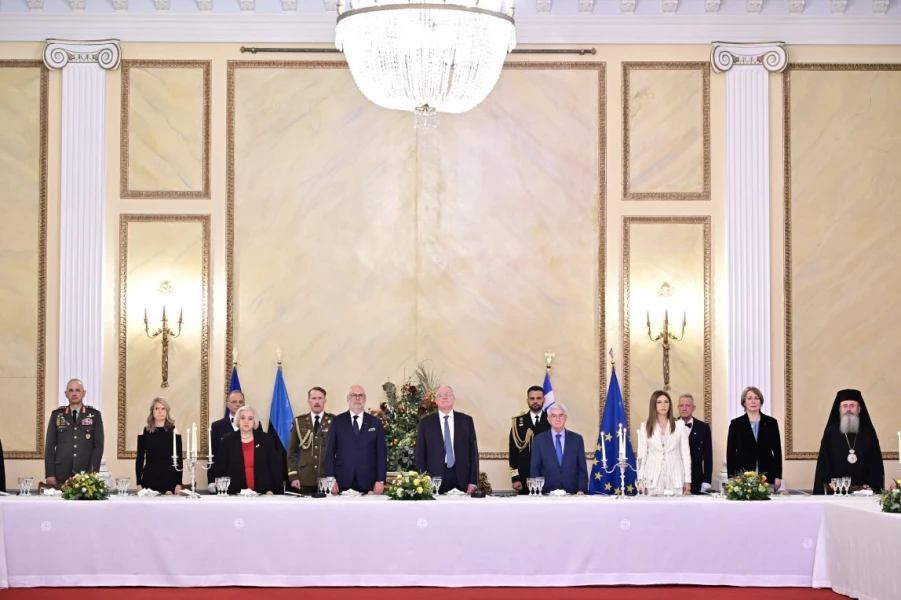
Referring to the modern era, he stressed that “the friendly ties that bind us have been strengthened by our participation in the European Union, NATO and other international organizations. Indeed, 2026 will mark 22 years since your country’s official accession to the European Union and it is particularly gratifying that the Treaty of Accession of Estonia was signed here in Athens under the Greek Presidency. Moreover, in 2022 our countries celebrated the 100th anniversary of the establishment of official diplomatic relations and it was on this occasion that my predecessor visited Estonia four years ago.”
At the same time, he noted that “our bilateral relations are constantly developing in a wide range of areas from the defence industry to digital governance, in which your country is a pioneer, to education and from innovation to tourism. And I am confident that your visit to Greece will contribute significantly to further promoting our cooperation, producing results that are mutually beneficial and perceived by our two peoples.”
Speaking about international developments, he argued that “the international order built after the Second World War, based on the strength of international law, the prohibition of the use of force and the peaceful resolution of international disputes, is in danger.” He said that “phenomena of revisionism and aggression, as well as flagrant violations of fundamental international norms and principles are multiplying every day” and added that “the unprovoked and illegal Russian invasion of Ukraine has made it dramatically clear that peace cannot be taken for granted in Europe. Our support for Ukraine has been unwavering from the outset and will continue to be so. For Greece, this is a one-way street, especially in the light of the 52 years of continued illegal Turkish occupation of Cyprus.
At the same time, he observed, “the conflict in the Middle East is endangering regional security and stability, as well as the global economy and freedom of navigation, making it imperative to de-escalate and peacefully resolve the crisis with Iran” and added that “at the same time, it remains necessary to implement the Gaza peace plan, with the ultimate goal of resolving the Palestinian problem on the basis of two states.”
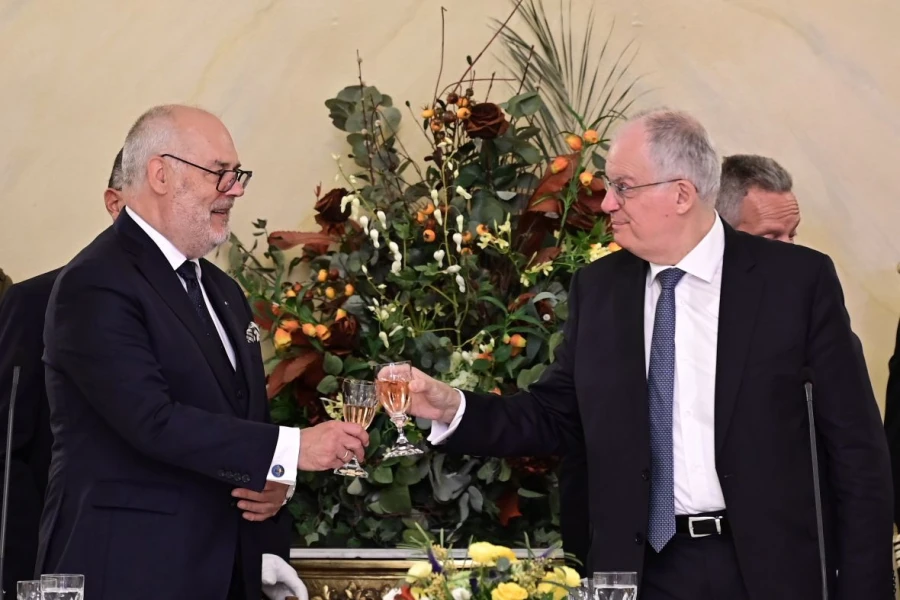
These developments and, more generally, multiple contemporary challenges such as hybrid threats, climate change and rapid technological advances have highlighted the need to strengthen the strategic autonomy of the European Union and to take proactive initiatives in all fields, from defence and security to competitiveness and innovation.
In this context, he noted that “we are pleased to note that Estonia and Greece are in favour of an ambitious multiannual budget for the European Union, giving priority to issues such as defence preparedness, cross-border connectivity, especially in the energy sector, strengthening the Common Agricultural Policy, safeguarding cohesion and promoting convergence between Member States.” Tasoulas stressed that “Greece and Estonia remain committed to the need to strengthen international legitimacy, multilateralism and European unity” and concluded by saying that “in this spirit, I am confident that our cooperation will continue to develop, becoming a model of bilateral relations within the wider European family”.
For his part, Estonian President Alar Karis, in his response, argued that “although Estonia and Greece are at opposite ends of Europe, we understand each other better than one would think at first glance.”
As he said, “Greece gained its independence some 200 years ago, Estonia a century later. Both of us had to fight for our independence and therefore we know the pain and loss, but also the courage and determination that comes with it. We both succeeded – because we believed in ourselves and in our cause.”
In the same context, he stressed that “Estonia and Greece are and will remain partners in the European Union and allies in NATO. We have cooperated in various efforts, in the United Nations and in other international organisations. We have common views on many issues, such as strengthening our security and defence, EU enlargement, digital transition or mutual support for our candidacies in various organisations.”
He even said that “both of us have a large neighbour that often poses problems, if not direct threats to us. That neighbor will always be there. So we both have to find ways to deal with him, to contain him, to contain him.”
He also noted that “overall, the world and the international order as we knew it are collapsing around us. We are faced daily withunprecedented and sometimes unimaginable challenges. The crises are piling up. In such a situation, it is of paramount importance that we remain true to our values and international law. We need each other’s encouragement and support – only together can we become stronger.”
He recalled that “Greece is currently a member of the UN Security Council, while Estonia is a member of the UN Human Rights Council. Both of us are working on parallel fronts with the same goals and objectives – to ensure peace, security, respect for fundamental values, democratic principles and human rights.”
However, he noted, “Unfortunately, in today’s world, this is not enough. Therefore, we must take bold and swift action to ensure that both our collective and national security and defence are strong, reliable and deterrent.” He argued that “Europe is moving in the right direction – enough incentives and reinforcement measures have been made available. Time and speed are crucial here. Both Estonia and Greece are trying to make the most of this opportunity. After all, defence spending in our countries has for many years been the highest per capita in NATO. Today, several Estonian defence start-ups are cooperating with Greek partners. Greek defence industry players are investing in the Estonian defence sector, especially in terms of modern warfare technology.”
He regretted that these investments are not directed towards cultural or social cooperation, and noted that reality requires us to be adaptable, flexible and resilient.
Referring to Ukraine, he stressed that “there are not many countries in Europe that have experienced what it means when your families are displaced or driven from their homes by violence and malice. Estonians and Greeks know this. This is what motivates us today to support the people of Ukraine in their struggle for freedom, democratic values and a future among us.”
He added that “Ukraine’s struggle is not just about Ukraine. It is about all of us. It is about Europe. We must continue to stand by her side and put the maximum pressure on the aggressor,to ensure that peace is just and lasting and that those responsible for atrocities and destruction are brought to justice.”
He went on to observe that “as we look to the southeast, the people of the Middle East, Gaza and beyond, deserve lasting peace, security and a meaningful future. The unrest must stop, not spread.”
Speaking about shipping, he noted that it has traditionally been one of the most important pillars of the Greek economy. He said “it faces various challenges due to the ongoing conflict in Iran, unfair competition in global waters and strict environmental standards. Estonia is suffering the consequences of the existence of the Russian shadow fleet operating in the Baltic Sea beyond our control. There is a serious need and potential here for a constructive cooperation between our countries to try to tackle these illegal shipping practices.”
She also made a special reference to innovation in education, underlining the support that schools need in order to adapt to the age of artificial intelligence. “Today, I had the valuable opportunity to see what Greece is doing in this area and I was pleased to see that we are moving in the same direction, towards the same goal. In Estonia, we have launched the AI Leap programme for students and teachers of upper secondary (high school) education and we are ready to share our experience,” he added.
Finally, Alar Karis reminded that “Greece is and will always remain a desired holiday destination for Estonians, a place where we can enjoy the warm and sunny hospitality of your great nation” and concluded by saying that “your people are equally welcome to discover the quiet and slightly cooler beauty of Estonian nature and its landscape”.


