

The transition of the Greek Government to a new, integrated and personalized model of service was demonstrated by the discussion held at the A&R Expo.
The focus was on major projects digital transformation, the role of the Information Society, the use of AI and the development of the new CRM for citizens and businesses.
As highlighted during the event, the Greek public sector is moving dynamically towards a model of operation without “barriers”, with an emphasis on interoperability, data utilization and the integration of cutting-edge technologies that form a more effective and reliable relationship with the citizen.
Director General of Information Society Projects, Dimitris Yantsis, presented the breadth of the organisation’s portfolio, noting that “we manage more than 440 digital transformation projects, with a total budget of approximately €3.9 billion”. At the same time, he stressed that “the aim is not to demonstrate technology, but to substantially improve the daily life of citizens and businesses”.
The main point of discussion was the Unified Digital Infrastructure for the service of citizens and businesses (CRM), a project implemented in the framework of the National Recovery and Resilience Plan “Greece 2.0” with the funding of the European Union – NextGenerationEU.
As Mr Yantsis said, “CRM is not just an information system, but a change of philosophy in the relationship between the state and the citizen”, as it aspires to become a single point of service with a personalized character.
At the same time, he stressed that “the citizen will be served through single channels, such as gov.gr, KEPs and a new five-digit call centre with artificial intelligence support”, while the system will be enhanced with AI technologies for voice recognition and natural language, with the ability to refer to a human representative where required.
Special mention was made of the creation of a single citizen and business profile, with Mr Yantsis noting that the aim is “to get to know the citizen through his profile, so that the state can operate more proactively and more targeted”.
In terms of the timeline, he noted that the first phase of the project is expected to be completed by 30 June 2026, followed by a phased start of production operations.
Digital Justice and Data Infrastructure
Mr. Yantsis also referred to the significant progress recorded in the Justice sector, noting that projects such as telejustice, the integration of information systems and the digitization of court records are at an advanced stage of implementation. He noted that some projects have already been completed, while the rest are expected to be completed within the first half of 2026.
He also stressed that the utilization of AI is directly linked to infrastructure, noting that “the utilization of AI requires strong computing infrastructure, such as the Government Cloud and Government Data Centers.”
Data, Security and Trust
She also placed particular emphasis on the importance of data governance, security and trust. As he pointed out, the success of the projects depends on the existence of a strong institutional framework, clear roles and responsibilities, as well as the implementation of strict cybersecurity and control practices.
In the same context, he stressed that data use will be based on the principle of minimization, with full compliance with the current data protection framework.
The Challenges of the Day Ahead
Despite the significant progress, he explained that the biggest challenges are not technological, but are mainly found in the need for a cultural change in the Public Administration and the strengthening of interoperability between systems and agencies – factors that are considered crucial for the successful completion of the digital transformation.
In this context, the A&R Expo highlighted that Greece is now at an advanced stage of implementing digital projects, with a clear vision for a modern, efficient and people-centric Public Sector.
The A&R Expo is the central hub for the design, development and implementation of the Ministry of Digital Governance’s Information and Communication Technology (ICT) projects in the Public Sector. It is at the forefront of the national digital transformation plan.


Dimitris Yantsis, General Director of Information Society Projects
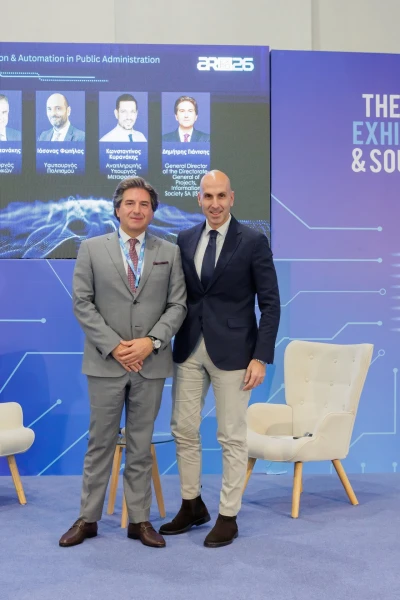
From left: Dimitris Yantsis, General Manager of Information Society Projects – Constantine Kintzios, Business Mentor/ Leadership Coach/Public Speaker
.


