The seventh lowest price in commodity in Europe is Greece. What does the cost drop, the comparison with 2019 and what consumers in other countries are paying;
To price compression for households and to the transformation of our country into a net exporter electricity have contributed to the radical improvements that have taken place in the last six years in the Greek energy market, such as the drastic increase in electricity production from renewable sources and investments in networks, government sources point out.
The change is strongly reflected in the wholesale electricity market. Although southern and eastern Europe is served by fewer interconnectors than in the north, Greece has the seventh lowest price so far for 2026. In contrast, in 2019 our country was the most expensive in the European system in terms of wholesale costs, which in turn put pressure on retail providers and ultimately consumers.
Greece’s improved position is reflected in its ability to maintain electricity prices at the European average even in the retail market, and even in purchasing power terms, which neutralises the different price level between Member States. This is despite the wider increase in energy costs following Russia’s invasion of Ukraine and the particularities caused by insularity.
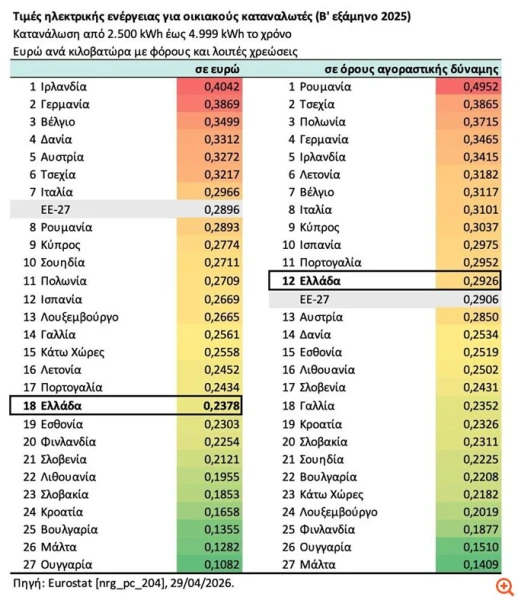
It is indicative that the final electricity price for Greek households in terms of purchasing power was in the second half of 2025, i.e. before the outbreak of the Gulf conflict, at 29.26 euros per 100 kilowatt-hours, essentially equivalent to the European average (29.06 euros / 100 kWh).
Our country actually ranks better than Spain and Portugal, countries often presented as models, but where prices were about 50 and 25 cents, respectively, more expensive than in Greece. Clearly more expensive was also Germany, the strongest economy on the Old Continent, where the corresponding price was more than 5 euros higher, at 34.6 euros, while Romania was at the top, where the cost of 100 kilowatt-hours reached 50 euros.
In absolute terms, Greece was the 10th cheapest country among the 27 member states of the European Union, with the retail energy cost for residential consumers estimated at 23.78 euros per 100 kilowatt-hours, while the EU average was 28.96 euros per 100 kWh, almost 22% higher than in Greece.
Greece an electricity exporter
The driving force behind Greece’s improved position on the price front is the jump in investment in solar and wind power plants from 2019 onwards, after a four-year stagnation.
In fact, thanks to the increased contribution of renewables, Greece has now become a major net exporter of electricity. For this year, our country is the 4th largest electricity exporter in Europe, and in 2019 we imported 18% of our needs.
It is indicative that between 2015 and 2019, the installed photovoltaic capacity in Greece increased from 2.6 GW to 2.8 GW, i.e. by just 0.2 GW, which corresponds to 7.7%, according to the International Renewable Energy Agency (IRENA).
On the contrary, starting in 2020 and until 2025, the installed capacity of solar plants was boosted by 296%, i.e. almost quadrupled, to 11.1 GW last year. It is also noteworthy that the rate of integration of new PV generation capacity has accelerated over the years, with 4.4 GW added to the system between 2023 and 2025 alone.
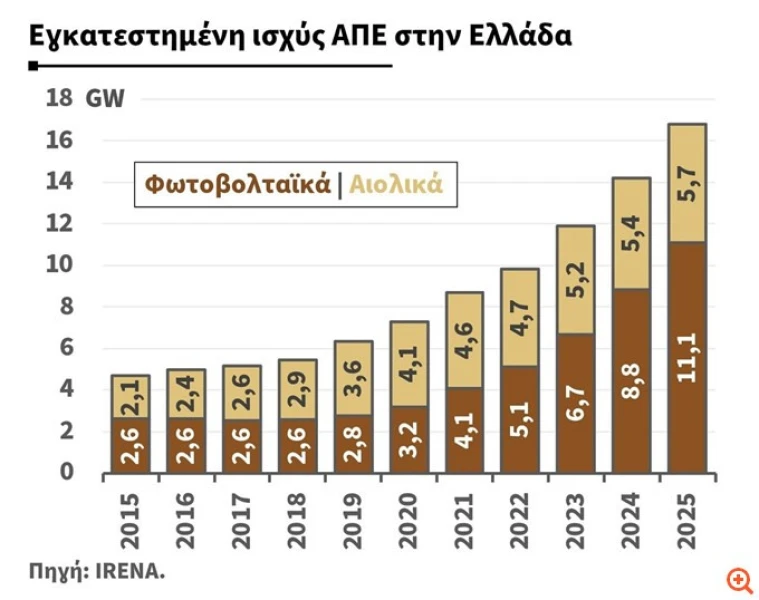
The increase in the contribution of wind farms has also been spectacular, with capacity increasing by almost 2 GW over the past six years, and between 2015 and 2019 it had increased by around 1.5 GW.
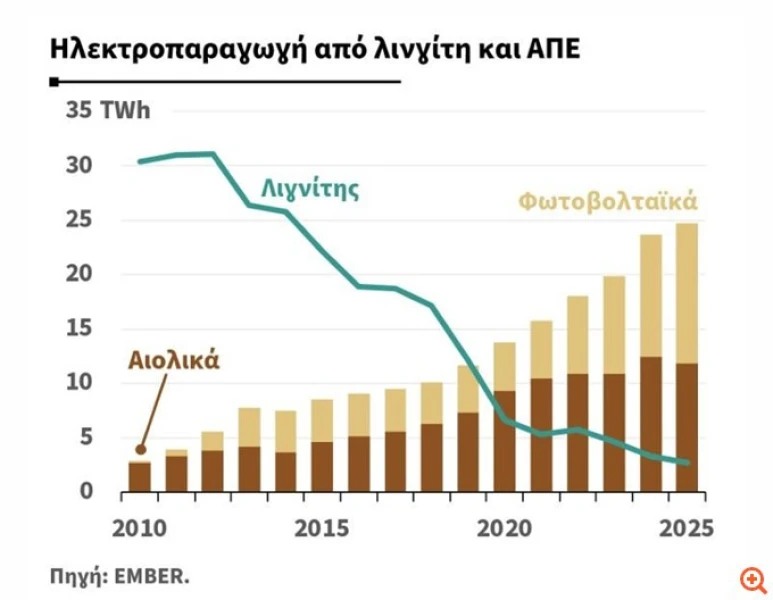
Thanks to this new data, Greece can systematically meet about 50% of its electricity needs by harnessing sunshine and wind, with electricity generation from renewables in 2025 reaching 25 terawatt hours, according to data from Ember, a think tank specialising in the green transition. The use of lignite, by contrast, which requires very expensive emission rights, has been shrinking.
Investment in grids
Investment in renewables has been accompanied by a parallel surge in investment in grids. In the period 2020-2025, around €6 billion was channelled into networks, compared to just €1.6 billion under the SYRIZA government.
The abandonment of networks between 2015 and 2018 is further betrayed by the fact that compared to the period 2012-2014, investment was down by 21%.
Thanks to the wave of investment in recent years, interconnections between islands and the mainland are progressing, as are other initiatives such as the installation of smart meters and undergrounding.
Multidimensional strategy
Greece, however, is also exploring whether it has undersea gas deposits, with the first exploratory drilling in the Ionian Sea expected to take place in the first quarter of 2027.
Government sources explained that any discovery of exploitable deposits, either in the Ionian Sea or off the Peloponnese and Crete, would boost Greece’s position as an energy security provider for southeastern Europe, while also securing obvious geopolitical advantages.