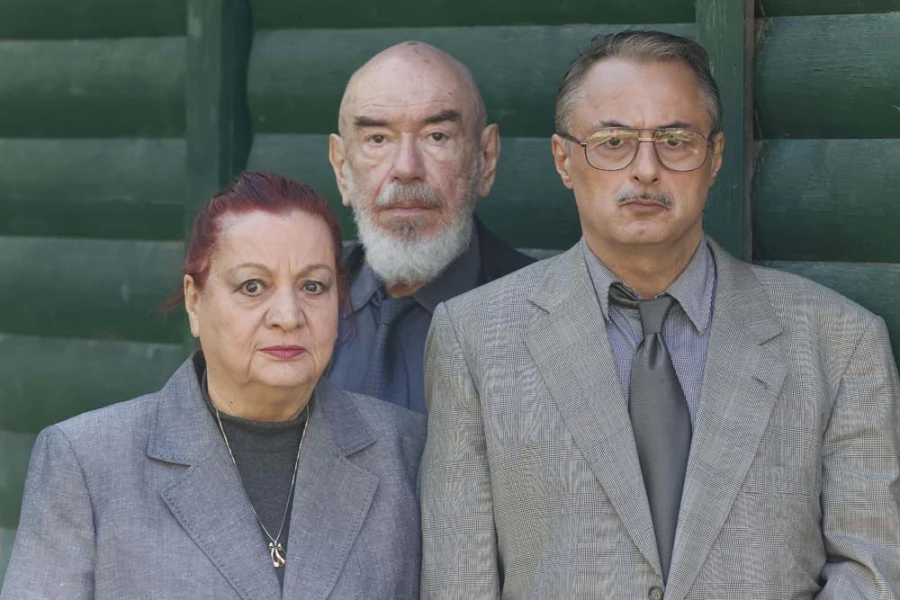
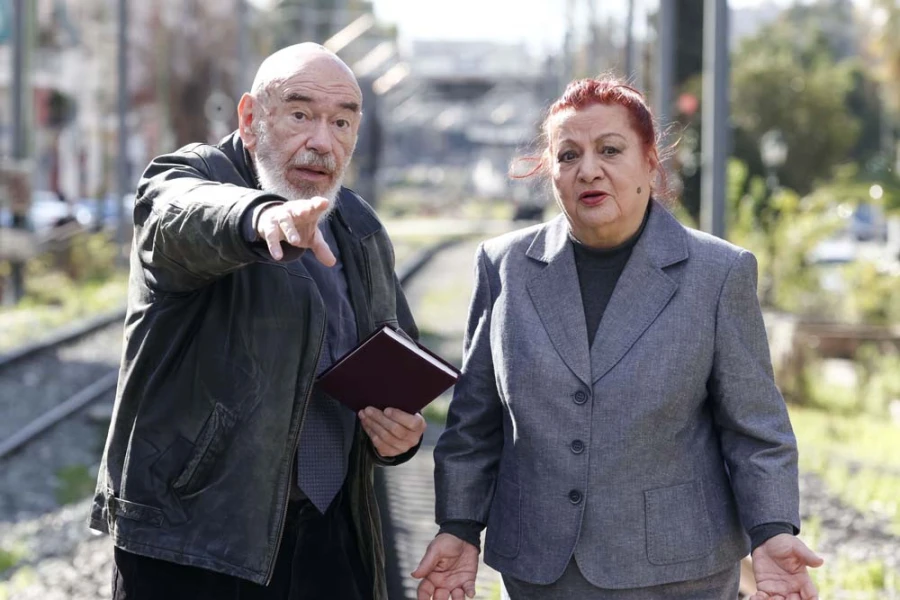
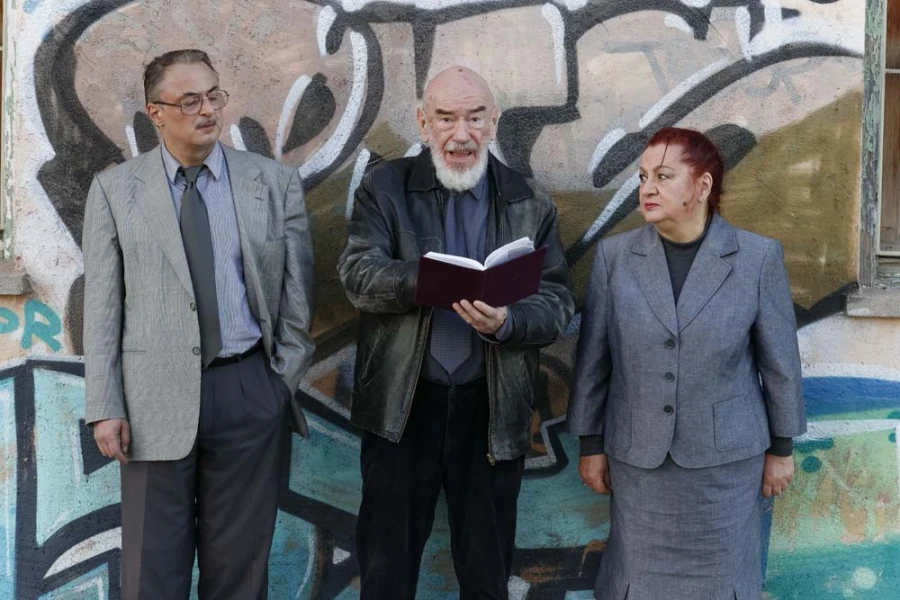
actress Mairi Razi opens her heart in a revealing interview about the new stage show she’s starring in.
The erotic thriller The Lovers of Viorn by Marguerite Duras, translated and directed by Sotiris Tsoga is full of tension, mystery and twists and turns, and is about love, betrayal and punishment.
The beloved actress and thespian talks about the power of theatre, the fine line between guilt and punishment, and the personal moments that marked her during rehearsals. At the same time, she reveals unknown aspects of her personal life, her relationship with her grandson Perseus and the big TV comeback she is preparing.
I consider it one of Marguerite Duras’ most important works for this time period. It is timely because it speaks about violence, domestic violence, femicide, brutality. I find it terribly topical. It has been performed in 20 countries and translated into as many languages. It’s an award-winning play that’s not often produced. It is contemporary, very topical in all these extreme situations that we have been living in lately.
The play is based on a true crime. How did you avoid the show getting caught up in the “true crime” element?
Sotiris Tsogas’ reading of the text was based more on the existential problems of each character. The path of the heroine’s life led directly to this crime. Marguerite Duras is very concerned with the psyche of her heroes, with their worldview, with their interpersonal and social relationships. We could never get caught up in the logic of true crime.
You describe the show as a “psychological erotic thriller”. Where do you ultimately give more weight?
It’s a psychological erotic thriller. Love plays an important role in all people’s lives, it follows that it plays a role in the heroine’s life as well. She fell in love and was betrayed by the great love of her life, whom she believed as her god. So when this “god” lied to her, she made a suicide attempt to drown herself in a lake. She later met her husband, Pierre Lan, and had a failed marriage because she never loved her husband. Marguerite Duras captures the impasse of the minds and souls of all the heroes in a masterful way.
Duras’s writing relies on allusions and silences. How do you work scenically with these “gaps”
In fact, the action writing doesn’t provide solutions that an audience would expect. The silences are subterranean, done in the subconscious. The journey of the roles is mesmerizing.
Time in the play is not linear. How is this constant movement between present and memory rendered?
It is a challenge for an actor to be in the objective space and time of his performance at the same time and then immediately jump into the past, jump into the future. That is, suddenly the heroine says: “I think it’s a terrible thing to know that he’s very clever and to know that all that great mind he has will roll with him into death.” He gives answers about the course and the end of the mind. One’s mind is lost along with one’s thoughts when a person dies.
How difficult is it to keep the tension in a play where the action is internal rather than external?
The action is internal and has great potential. The actor has to be very, very focused to be able to keep the thread of internal action taut, continuous, energetic. His thoughts have to be sequenced. Of course, an external tension also needs its technique.
How close do you get to “taking a stand” on the crime and how much do you let the viewer decide?
As an actor I have a position on the crime, but I leave some thoughts, some questions for the viewer about the action of the murderess. I excuse her because her husband was oppressing her so much that this woman slowly went mad from the domestic violence she suffered. I love this heroine very much and I leave room for the viewer to take a stand and ask a few questions, whether she really did kill her cousin or whether, because of the slope of the house leaning to one side, her cousin tumbled down the stairs and found her dead in the basement, panicked and chopped her up. Marguerite Duras doesn’t make it clear, leaving many questions for the viewer.
Love here is associated with violence and punishment. Do you think this reflects a timeless truth?
An eternal truth. Love is often associated with violence, with tensions, with punishment, with contradictions, with multiple emotions. The definition of love is not easily interpreted. Love is often blind, it overwhelms you. The heroine says at one point: “This love with the policeman of Kaor flooded my whole life, in the end it drowned it”. That’s what love does.
In an age of rapid consumption, is this a show that requires more concentration from the viewer?
Yes, it requires concentration because the viewer can’t miss a single word. The text requires the active participation of the spectator in the action and that is why not a single click is heard during the performance. The spectator watches with great concentration, with great interest, is carried away by the text and many times at the end of the performance they say to me: ‘How did the time pass, we didn’t understand it’. Time passes very easily and usually we would like there to be more text. These are the great gifts that the audience gives us. In an age of speed, where everything happens too fast, theatre in culture performs a very important task.
Was there a moment in rehearsals when you felt that the material overwhelmed you morally or emotionally?
During rehearsals I encountered a lot of difficulties. I felt the weight of such an important role, but I faced it with courage.
Do you think audiences today have a different understanding of the concept of guilt and punishment?
I don’t know what the public today may perceive about the concept of guilt and punishment. What I do know is that once one feels guilty and bears the burden of some guilt, that does not change. Today’s viewer may not perceive the concept of guilt any differently than an older viewer. Guilt is always the same anyway. On the other hand, punishment is imposed so that there are limits. Even at a very young age in school, when we make a mistake, when we overstep the boundaries, we receive punishment. Man has rights but he also has obligations within a framework of self-respect, mutual respect, solidarity, honesty, purity, sincerity. These concepts do not change.
What would you say to an audience member to convince them to see this show?
I would tell them not to miss it because it is one of the most important works in the world repertoire. A rarely performed text, a psychological erotic thriller. It’s a play full of tension, mystery, twists and turns, about love, betrayal and punishment. It is a show that has received rave reviews for the direction and performances of the actors. It is well worth seeing for theatre-going audiences.
Will we see you on TV soon or does theatre remain your conscious choice?
Of course theatre remains my favourite choice, but I also love TV very much. Yes, I’m going to start filming a very important work, which will air from November onwards. I’m very excited about my return to television.
In the industry, impressions are often created about artists. Have you ever felt misunderstood?
No, I’ve never felt misunderstood. I am very much loved by my colleagues, I have not given anyone the right to misunderstand me. On the contrary, the whole industry and all my colleagues and all the people I have worked with, actors, directors, set designers, love me very much. I receive love, appreciation and they call me Mary, not Mary. This is a great gift I receive from our congregation. But I also love and respect them all. I’ve never said a bad word about anyone, it’s just my character. I am upbeat, positive energy and bright thinking. I banish all black and negative energies with a special mechanism I was taught by my family.
Have you been in a TV partnership where the tension crossed the line and became personal? How did you handle it?
I’ve never been in a situation like that before. Barely for me, shooting TV is like going on a five-day field trip with the school. It’s a great joy because I get to meet colleagues I haven’t worked with in the theatre and we become a group. We do our work well. I have nothing but joy to derive from this profession. I don’t remember any bad moments.
As a grandmother, how do you experience this role in your life and how do you dream of Perseus’ future?
I’m laughing because I’m really enjoying the role of grandmother. I like it because I have more time to deal with Perseus. Once a week we go for coffee. God makes him coffee what I drink, he puts cinnamon, sugar sachets a bunch, mixes it up and gives me this special coffee to drink. Now that he’s 3 he orders babyccino with a casual attitude. Perseus is a great artist. He sings, speaks very good Greek and is only three years old. He blurted out that he’s an actor. He’s a face. I hope Perseus’ future is full of rose petals, that he is happy and joyful and that everything in his life is only rosy. May he keep that spontaneity, naivety, sensitivity, kindness, his wonderful laughter, and never be sad. I adore him, but I can’t help talking about my daughter, Coralia, who, together with her husband, Hyacinth, gave me Perseus. I wish them all the best!
A few words about Marguerite Duras’s The Lovers of Viorn
Marguerite Duras inspired the play from a real event that shocked France.
On 8 April 1949, a human body part was discovered in France in a freight train carriage. Over the next few days, in France and elsewhere, inside other freight trains, they go on to find more parts of the same body. Only one thing is missing: the head. It was never found.