
A criminal organization has been dismantled; its members were involved in widespread electricity theft and illegal tampering with electricity meters electricity in various regions of the country.
The Northern Greece Sub-Directorate for Combating Organized Crime a criminal organization has been dismantled that is alleged to have caused total damages exceeding 9 million euros through widespread electricity theft and illegal tampering with electricity meters belonging to HEDNO, across much of Greece, using—in some cases—a methodology that is unique worldwide.
In connection with the case five people were arrested, including three key members of the organization, following a major police operation carried out yesterday morning in Thessaloniki.Charges were filed against them, as well as against another 101 individuals and legal entities, on a case-by-case basis, for forming and participating in a criminal organization, aggravated theft, fraud, theft, disruption of information systems, and aggravated damage to digital data, committed in concert and on a continuous basis, as well as violation of the law on weapons.
The five arrested individuals appeared before an investigating judge
The five arrested individuals were referred to the 7th Regular Investigating Judge of Thessaloniki to answer the charges. The prosecutor filed charges against them, as appropriate, for aggravated electricity theft, criminal organization (gang), interference with the operation of information systems, electricity theft—both simple and of particularly high value—money laundering, and illegal possession of weapons.
Ongoing operation since 2017
As stated in a police announcement, following months of methodical, and thorough investigation, in collaboration with the relevant departments of HEDNO, it emerged that the three key members of the organization had formed, at least since 2017, a structured and continuously active criminal group, with the aim of engaging, on a professional basis—with the same or different members each time— to carry out illegal tampering with HEDNO’s analog and digital electricity meters in various regions of the country and to obtain illicit financial gain (Attica, Thessaloniki, Serres, Kilkis, Chalkidiki, Kavala, Pella, Imathia, Pieria, Evros, Xanthi, Larissa, Trikala, and Ilia).
According to the same announcement, the illegal interventions were carried out at the request of individuals and legal entities who were contracted users of electricity services. The purpose of these interventions appears to have been to reduce the recorded electricity consumption compared to actual consumption, resulting in large-scale electricity theft for the benefit of the users, as well as the criminal organization itself.
The members of the organization had developed a specific modus operandi, which varied depending on the type of electricity meter, on which they carried out the illegal tampering. More specifically, with analog meters, they carried out all sorts of unauthorized actions, such as tampering via jumpers, splices, interventions on coils, breaking seals, isolating wires and voltage coils, etc., thereby achieving a significant reduction in the recorded electricity consumption compared to what was actually consumed.
‘
“Sophisticated software”
According to the police, they used an even more sophisticated and globally unique methodology on EDMIATLAS-type digital meters. Specifically, they used specialized illegal software (firmware), which they installed in the meter’s body using a special optical head. In this way, they gained unauthorized access to the meter’s software and to HEDNO’s telemetry information system, through which electricity consumption data was transmitted online.
They then entered specific scaling factors and application time parameters into the meter’s software, which they used to predetermine the percentage reduction in recorded consumption and the duration of the tampering, resulting in the alteration of the consumption data that was recorded and transmitted to the HEDNO telemetry center.
The long-term use of this specific software resulted in the continuous alteration of the transmitted data and the disruption of the operation of HEDNO’s telemetry information system. At the same time, these interventions made it impossible for the relevant HEDNO departments to access the actual data on the electricity consumed by the affected households
In many cases, the interventions were periodic in nature, as members of the organization returned on a monthly, quarterly, or semi-annually to update the scale factors and other parameters that influenced the reduction in recorded electricity consumption. This practice gave their operation the characteristics of a “subscription service,” ensuring a continuous flow of illegal revenue.
In fact, the members of the organization are alleged to have developed the capability to remotely monitor electricity supply data, which allowed them to track consumption figures, meter activations and deactivations, and other technical data regarding the connections they had tampered with. Tampering using the aforementioned illegal software was detected in a total of 88 digital meters.
A world first
It is noteworthy that the manufacturer of these banknotes—as stated in the relevant police announcement—described the tampering as the most sophisticated incident ever detected internationally among more than two million meters of the same type in operation worldwide. Due to the novelty and technical complexity of the software used, a special diagnostic tool was developed to detect these specific tampering incidents.
The investigation also revealed that the organization’s activities were not limited exclusively to cases of electricity theft. Specifically, in two cases involving photovoltaic installations , illegal tampering was detected, aimed not at reducing recorded consumption, but to artificially increase the amount of electricity shown as generated, with the aim of providing illegal financial gain to those involved.
Structure and Roles within the Organization
To achieve their goal, the members of the organization had clearly defined and distinct roles, which, according to the Hellenic Police, were as follows:
– A 52-year-old man: played a coordinating role, providing guidance to the other members regarding unauthorized—and illegal—tampering with electricity meters, as well as acting as the principal perpetrator, especially when digital meters were involved, while he determined the amount of payment they received from consumers on whose behalf and for whose benefit the tampering was carried out,
– 40-year-old: played a primarily operational role in the commission of the criminal acts and was tasked with carrying out the illegal tampering with the electricity meters, while also, on a secondary basis and —on a case-by-case basis—he acted as an intermediary, relaying the 52-year-old’s orders and instructions to members who carried out the illegal tampering with meters,
– 43-year-old: had a purely operational role in the commission of the criminal acts and was tasked with tampering with the electricity meters and collecting payments from consumers.
Scope of the cases and companies involved
As it turned out, a significant number of the affected utilities involved high-energy-consumption businesses, such as gas stations, restaurants, internet cafes, industrial meat, food, and dairy processing plants, as well as olive oil mills. In numerous cases, a common ownership or family connection was found among the individuals and businesses involved, as well as a chronological sequence of the illegal interventions. In fact, in several of these cases, the damage caused by the unrecorded electricity exceeded 100,000 euros per connection.
According to the investigation, to date, 606 instances of tampering on electricity meters, involving 103 cases of electricity theft, with the total financial loss amounting to 9,163,354 euros. Additionally, two cases of alleged fraud were identified involving the illegal inflation of the reported amount of electricity generated; the exact financial implications of these cases are still under investigation. It is estimated that the criminal organization profited at least 371,000 euros from the above illegal activities.
Seizures from the police operation
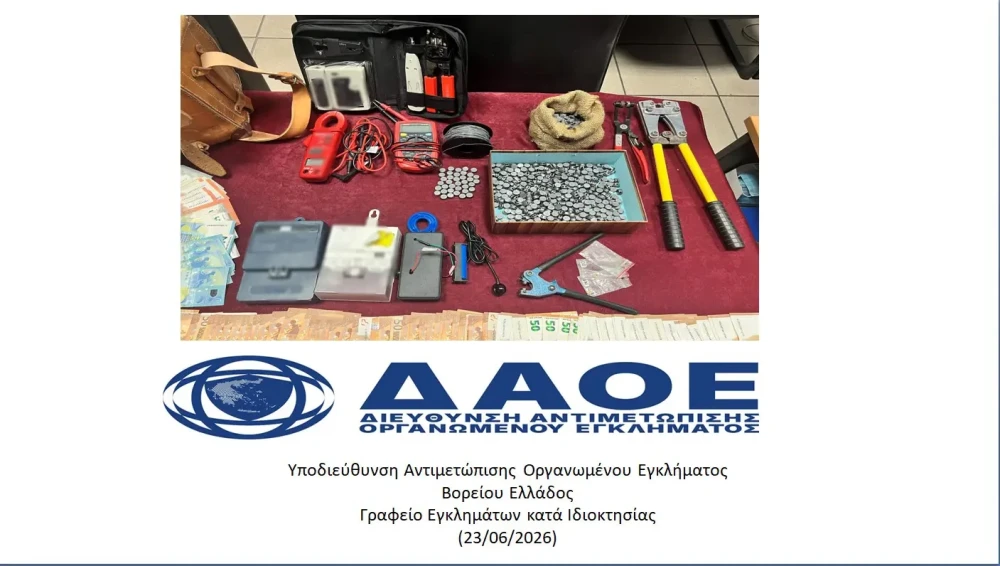
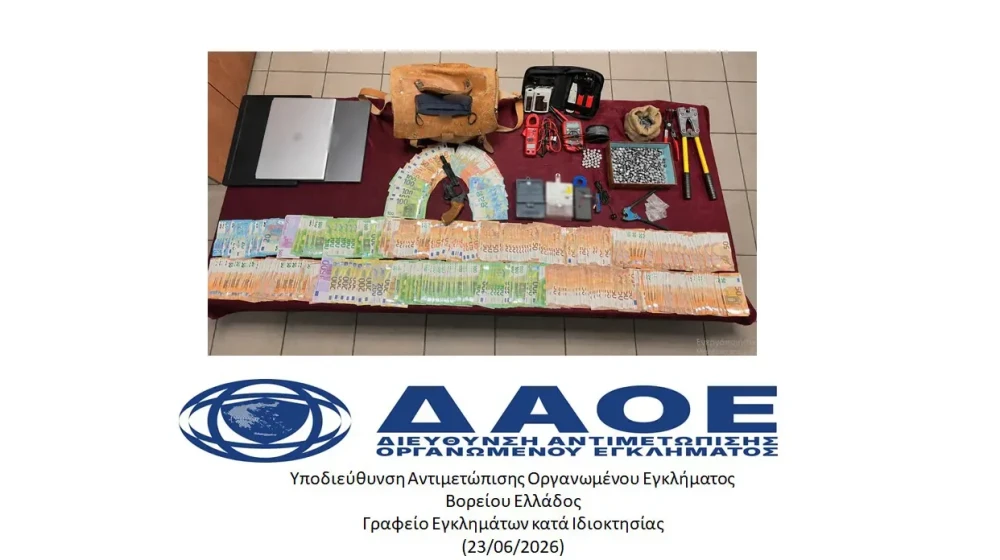
During the operation, searches were conducted in residences, vehicles, and business premises where—among other items—the following were found and seized: a 9 mm revolver, a gas-powered flare launcher with a flare-launching funnel, two radio-frequency remote-control receivers (owned by the Public Power Corporation) used to activate/deactivate the nighttime (reduced) rate, monitor electrical loads, and send commands to meters without requiring a visit from a Hellenic Electricity Distribution Network Operator (HEDNO) crew.
In addition, 417 round lead seals for HEDNO electricity meters were confiscated, 574 rectangular lead seals, small-diameter barbed wire used to secure HEDNO electricity meter lead seals, a code-stamping press for HEDNO electricity meters, complete with dies, five dies for different lead seal codes for HEDNO electricity meters, a meter cable terminal crimping press, yellow-silver in color with black handles, a meter cover seal press, silver-black in color with red handles, a spool of barbed sealing wire for lead seals, 42 lead seals, an electrical multimeter, an electrical current clamp with terminals, an electronic kit for making Ethernet cables and connectors, a COM port (serial) to USB cable, a portable electronic device tester with an external power supply and battery, an infrared optical sensor, the sum of 24,970 euros, etc.
Cases of electricity theft caught in the act
Furthermore, as part of the inspections carried out by HEDNO crews at electrical service connections, stores, and businesses examined during the investigation of the case, two cases of electricity theft were detected in the act, for which the two legal representatives—owners of the businesses involved—were arrested.
Specifically, in one case, it was found that an electricity supply that had been disconnected since 2019 had been reconnected without authorization and was being used to power businesses, with the estimated loss amounting to 65,775 euros, while in the second case, an illegal bypass of a business’s three-phase meter was discovered, resulting in 6,532 kWh of electricity going unrecorded and a financial loss of 4,401 euros.
The arrested individuals, along with the case file compiled against them, are being referred to the competent prosecuting authority.


