

At least 235 people were killed by the devastating double earthquake that struck Venezuela.
Teams of specialized rescue workers, in coordination with the UN, are on their way to assist in the search for people trapped in the rubble
The search efforts continued yesterday, Thursday, at a frantic pace amid the rubble of collapsed buildings as part of the rescue operations for those trapped. “Unfortunately, we received 235 patients who were brought in without vital signs or who died upon arrival at our healthcare facilities,” said Health Minister Carlos Alvarado on public television.
He did not specify the number of injured. Authorities had earlier reported at least 1,520 people.
Buildings reduced to rubble, mountains of debris, where distraught families were trying to find people buried alive: near the epicenter of the earthquake, Agence France-Presse teams witnessed horrific scenes of destruction, raising concerns that the death toll will continue to rise.
The area hardest hit is the state of La Guaira, north of the capital Caracas, where the Simón Bolívar International Airport in Maquetía —which was closed due to the damage it sustained—and the coastal city of Catia la Mar, where many buildings collapsed.
“No tools”
Like the one where Antonio Bermúdez lived. “There was a point where a young woman, Jennifer, who lived on the 11th floor, answered me. ‘But we don’t have any tools, any way to help’ her get out of the rubble,” he explained.
Lisbet Vazquez, 37, told AFP that her family members managed to save themselves by jumping out of the windows of their family apartment at the last moment as the building “was completely collapsing.” “It was terrifying,” she said. “Neighbors on lower floors were buried; we’re trying to dig them out.”
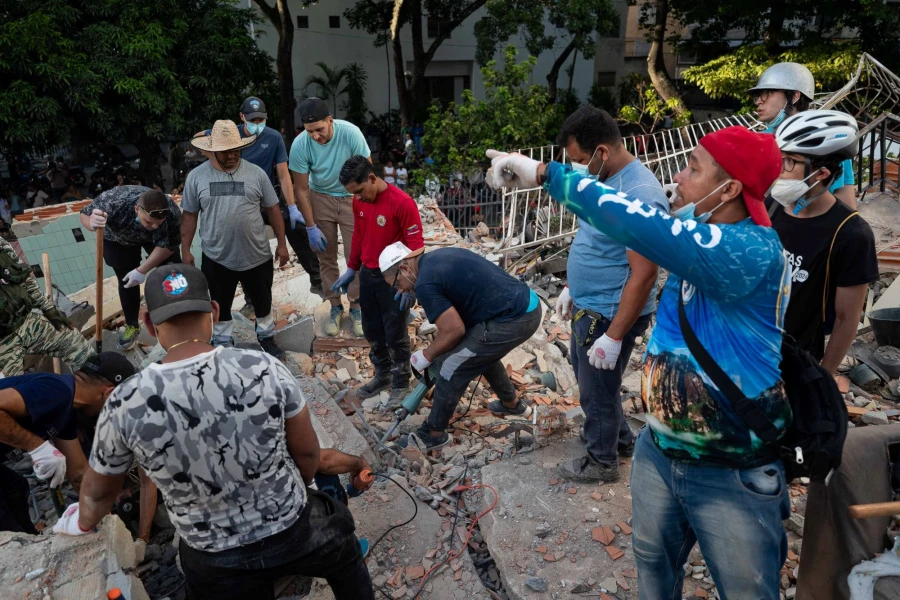
“We have nothing left. Nothing, not even the strength or courage to go in there,” sighed Larry Rojas, 49, standing before the pile of rubble where his relatives are buried.
“We need people to come and help. A little girl has been trapped here since last night; we can get her out, but we need an excavator,” shouted in desperation Danny Riso, another 48-year-old resident of the same building.
International aid
International aid is beginning to be organized. The U.S. has promised “substantial,” “rapid,” and “effective” aid, according to Secretary of State Marco Rubio.
The State Department announced that it is sending rescue teams and allocating $150 million to provide aid through U.S. “partners”. The U.S. military announced that it is deploying warships, aircraft, and helicopters to provide support for search and rescue operations.
Brazil, two of whose citizens lost their lives in the earthquake, according to Brasília, also announced that it is sending aid to its neighboring country. As did China, India, countries in Europe and Latin America —even Iran, a traditional ally of Venezuela, even though it has suffered the same immense devastation due to the war waged against it by the U.S. and Israel on February 28.
“It’s shaking right now”
Acting President Delcy Rodríguez declared a state of emergency a few hours after the double earthquake measuring 7.2 and 7.5 magnitude earthquakes that struck on Wednesday at 6:04 p.m. (1:04 a.m. on Thursday, Greek time).
According to data from the U.S. Geological Survey (USGS), the 7.5-magnitude earthquake was the strongest to hit the country since at least 1900.
The country, with a population of nearly 30 million, has been mired in an economic crisis for years.
According to USGS data, the first tremor—the “foreshock,” as it was described—measuring 7.2 on the Richter scale, was recorded at 6:04 p.m. (local time; 01:04 Greek time) at a depth of 21.9 kilometers, about 200 kilometers west of Caracas. The second, measuring 7.5 on the Richter scale, with a shallow focal depth of 10 kilometers, followed 39 seconds later, 45 kilometers from there.
In the capital, where many buildings collapsed, the streets were littered with shards of broken glass, and many people spent the night outdoors, some in their cars if they had one, as the ground continued to shake from aftershocks.
There were reports of some looting. In Katia la Mar, men and women were seen leaving a store that had been partially set on fire, carrying food, Agence France-Presse reporters observed.
Power outages were reported by Interior Minister Diosdado Cabello, who also announced that he had ordered the natural gas supply to be cut off in order to “avoid any accidents.”
Yesterday morning, almost no stores opened, while traffic was heavy, as many residents sought to find safe locations away from buildings that were dangerous.
“It’s shaking right now,” they shouted during an aftershock as they gathered around a building that had already collapsed.
Even before the devastating earthquakes, “nearly eight million people were in need of humanitarian aid” in Venezuela, recalled the UN Deputy Secretary-General for Humanitarian Affairs, Tom Fletcher.
As the international airport in Maiquetía closed due to “serious damage to its infrastructure,” as announced by Acting President Rodríguez the day before yesterday, Caracas will rely on La Carlota Military Airport, in the metropolitan area, to receive international aid deliveries.


