

The Minister of Culture Lina Mendoni declared the opening of the 2nd World Congress of Classical Studies.
The conference is co-organized by the Athens Academy of Athens and the Chinese Academy of Social Sciences (CASS), in Athens, on the theme “Dialogue between Ancient and Modern: Contemporary Inspirations from Classical Wisdom: Contemporary Inspirations from Classical Wisdom”).
According to a statement from the Ministry of Culture, in her welcome address, the Minister of Culture noted that the Symposium in Athens, “the city where the foundations of political thought, political philosophy, democracy and the principles of participatory governance, dialogue and collective social responsibility were laid, adds a special symbolism to our work“, While stressing that its co-organization by the Athens Academy of Sciences and the Chinese Academy of Social Sciences “highlights in the most meaningful way the power of cooperation between two countries representing two of the oldest and most influential civilizations of humanity”.
The Minister stressed that “classical studies is now a truly global field of research and dialogue” and that “the study of the great civilizations of antiquity is not only about their heirs, it is about the entire international community, humanity, which continues to draw from them for knowledge, inspiration and guidance”.
Referring to the theme of the Conference, she pointed out that “the past is not a closed chapter of human history. On the contrary, it remains a constant and living source of ideas, principles and values, but also of answers to timeless and fundamental questions”, underlining that the great challenges of our time make the contribution of classical thought more relevant than ever.
A special place in her speech was occupied by artificial intelligence and its impact on modern society, with the Minister noting that “we are living in an era of rapid, profound and largely unprecedented transformations for humanity”, where “the digital revolution of artificial intelligence, rapid developments in biotechnology, but also environmental and energy challenges, the climate crisis and ongoing global geopolitical upheavals are rapidly changing the context of the human experience”.
Technological knowledge and self-awareness
The Minister asked, “Humanity today has more technological knowledge and power than ever before. But does it have the corresponding maturity and self-awareness to manage it?“, placing the issues of the ethical dimension of technological progress at the centre of the reflection.
Artificial intelligence and new technologies, the minister continued, “oblige us to rethink the boundaries between technical capability and moral responsibility”, bringing back in contemporary terms fundamental questions that concerned the great thinkers of antiquity: “How should this power be used? What are the limits of progress? What is the relationship between knowledge and virtue? How is the balance between individual and collective interest achieved?” Lina Mendoni stressed that contemporary concerns around scientific, political and social ethics are still linked to the thought of Socrates, Plato and Aristotle, while the teachings of Confucius, Lao Tzu and the great thinkers of the Chinese tradition offer valuable guidelines for social harmony, social cohesion and good governance in the new digital age.
Classical studies are not a relic of the past
In the same context, highlighting the crucial role of classical studies in the modern era, he stressed that “classical studies do not offer ready-made recipes. But they do offer something perhaps more important, the depth of historical experience and the foundations of critical thinking“, while clarifying that “classical studies are not a relic of the past. They constitute a necessary investment for the future.”
In cultural and academic relations between Greece and China, the minister stressed that “we attach particular importance to cooperation between academic and research institutions of the two countries”, describing the establishment of the Chinese School of Classical Studies in Athens as “a historic step”, which “enhances the role of Athens as an international centre of research and dialogue on classical civilisations”.
At the same time, he highlighted the importance of intercultural dialogue, noting that “cultures do not clash when they communicate with directness and sincerity, when they dialogue with openness and receptivity without prejudice”, but “lay the foundations not just to coexist, but to learn from and complement each other”.
Completing her speech, Lina Mendoni stressed that “memory must evolve into timely knowledge and a shared vision for the future. And heritage should be the raw material of creativity, progress and innovation”, expressing confidence that the Conference will contribute substantially to strengthening the global dialogue on the contemporary significance of classical civilizations.
Finally, quoting an old Chinese proverb, the Minister of Culture said: “When the winds of change blow, some build walls and others build windmills. In a time of great change and even greater challenges, let us choose to build windmills. Let us choose dialogue over isolation, knowledge over prejudice and cooperation over confrontation.
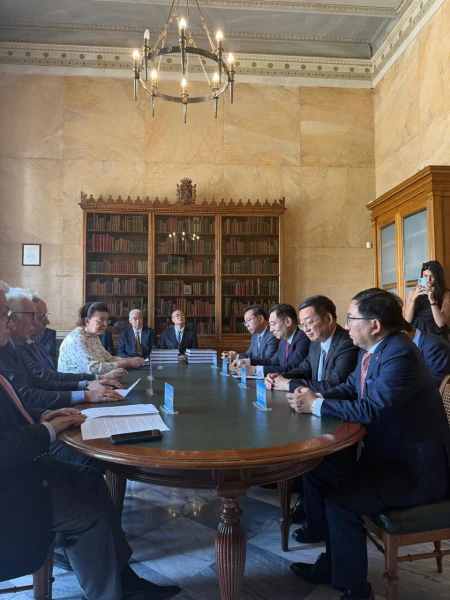
The opening ceremony was attended by Hu Heping, Executive Deputy Head of the Publicity Department of the Central Committee of the Communist Party of China (CPC), the President of the Academy of Athens, Nikiforos Diamanturos, the Vice Minister of Education, Religious Affairs and Sports, Nikos Papaioannou, and the President of the Chinese Academy of Social Sciences, Gao Xiang.
The conference proceedings are attended by distinguished academics, researchers and scientists from Greece, China and many other countries, confirming the international character of the event and the importance of the dialogue between classical wisdom and the contemporary challenges of the 21st century, among which artificial intelligence, new technologies and the ethical issues they raise.


